Common names
White Perch, Calico Bass, Speckled perch, Specks
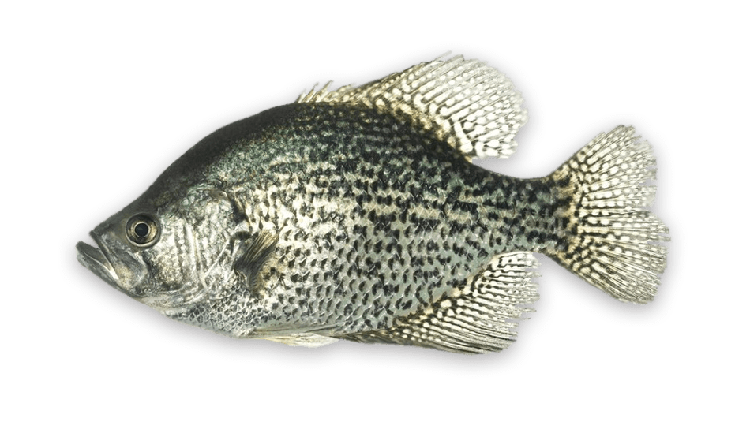
Pomoxis nigromaculatus
White Perch, Calico Bass, Speckled perch, Specks
Black crappie are most accurately identified by the seven or eight spines on their dorsal fin (white crappies have five or six dorsal spines). Crappies have a deep and laterally compressed body, the upper surface of the head and the forward part of the back are strongly concave. They are usually silvery-gray to green in color and show irregular or mottled black speckles and blotches over the entire body (no distinct vertical bars). Black crappies have rows of dark spots on their dorsal, anal and caudal fins. The two sections of the dorsal fin (spiny forepart and soft-rayed rear part) are broadly connected, without a notch between them. The dorsal and anal fins resemble each other in shape. Both crappies have large mouths extending to below the eye, and thin lips—both suggestive of their piscivorous feeding habits.
Their habitats are lakes, reservoirs, borrow pits and navigation pools in large rivers. They prefer areas with little or no current, clear water, and abundant covers such as submerged timber or aquatic vegetation, as well as sand or mud bottoms like those found in lakes, ponds, streams and sloughs.
Its native range is suspected to be in the eastern United States and Canada. As of 2005, populations existed in all of the 48 contiguous US states. Introduced populations also exist in Mexico and Panama.
They nest in colonies from February to April. Nests are fanned by males over gravel or muddy bottoms in depths of 3-8 feet, with big fish deeper. Primary food items are crustaceans, aquatic insects, and small fishes.
Excellent. Crappies are safe to eat and known among the most delicious species out there. They have high amounts of healthy fats, which provide lots of protein, therefore they are great from a nutritional perspective.
They will hit on lures, such as spinners, small (1-3in) crankbaits, and pan-fish jigs. Good bait: worms, insects, and small minnows.