Common names
Goldring, Silver perch
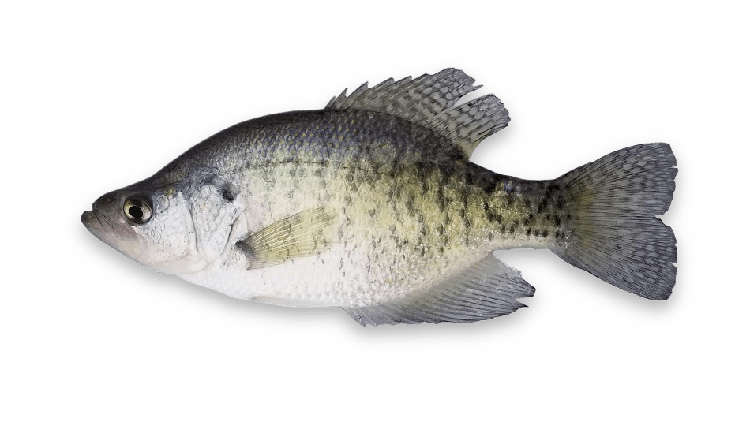
Pomoxis annularis
Goldring, Silver perch
White crappie have 5–10 dark vertical bars along their bodies, rather randomly scattered spots like the black crappie. They have a silvery colour with green or brown shades along its back with dark lateral bars along its side, and a white belly. They are deep-bodied fish with a flattened body or a depth that is one-third of the length of the fish. White crappies are morphologically similar to black crappies. Both species of crappies have a terminal mouth position with many small, conical teeth in two rows along the mouth. The dorsal fins start farther back on the body than those of the black crappie. The anal fin is about the same size as the dorsal fin. The white crappie has six dorsal fin spines, whereas the black crappie has seven or eight dorsal fin spines.
White crappies can be found in large rivers, low-velocity areas such as pools and backwaters of rivers, reservoirs and lakes. They are more tolerant of turbid (murky) waters than black crappies. The white crappie usually outnumbers the black crappie in turbid waters and in areas with little rooted aquatic vegetation.
White crappies are native to the Great Lakes, Hudson Bay, and the Mississippi River basins expanding from New York and southern Ontario westward to South Dakota and southward to Texas.
They swim intermittently and only search for prey when stationary. This strategy is considered a saltatory, or pause-and-travel search. Using this strategy, juveniles can grow rapidly in the first few days of life. This strategy is energetically favoured to reduce search time for the species. White crappies in the larval and juvenile stages of life eat zooplankton and continue to feed primarily on small invertebrates during their first year of life. The adults feed mainly on small fish such as minnows and young American shad, and large invertebrates such as crayfish and hellgrammites. Their diet can vary depending on their location.
Their white, flaky meat tastes sweet and delicate without a strong fishy taste. They have high amounts of healthy fats – also good tasting, but they also provide lots of protein, so they are great from a nutritional point of view.
Use small spinners, tube lures, soft plastic grubs, or twisters in colours such as white, black, green, yellow, or silver. Good bait: minnows, worms and insects. (white crappie aren't picky)