Common names
Dombrains Marlin, D'ombrain's Marlin, Pacific Black Marlin, Silver Marlin, Southern Marlin
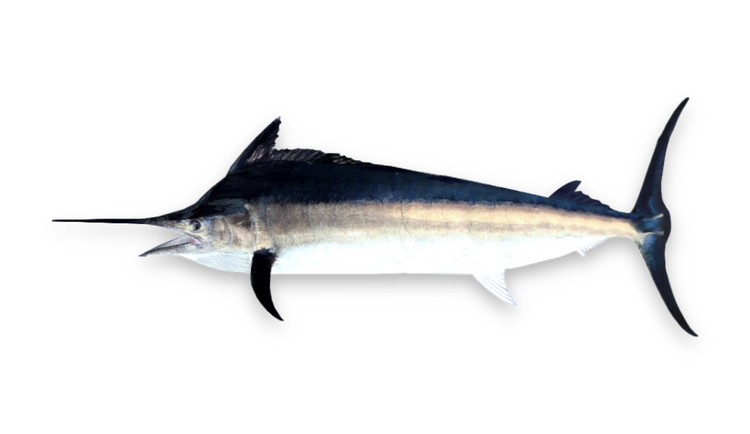
Istiompax indica
Dombrains Marlin, D'ombrain's Marlin, Pacific Black Marlin, Silver Marlin, Southern Marlin
The black marlin is the biggest marlin and one of the largest bony fish in the world. Its body is dark blue to blue-black on the back, with a striking silvery-white underside often separated by a yellowish chrome stripe. Compared with striped or white marlins and sailfish, the black marlin has a deeper and more solid body, a shorter and heavier bill, and a lower, rounder dorsal fin. Overall, black marlin have a broad, powerful build, unlike other marlin species that have more slender bodies with less depth from back to belly. A key distinguishing feature is its rigid pectoral fins, which cannot be pressed flat against the body.
This species is oceanic and found mostly in surface waters above the thermocline. They are often encountered near landmasses, islands, and coral reef systems, where baitfish are abundant.
They occur circum-Australia, including around Lord Howe Island and Norfolk Island. Black marlin are distributed throughout the Indo-Pacific, inhabiting tropical and subtropical waters and occasionally entering temperate zones. Although rare individuals may stray into the Atlantic via the Cape of Good Hope, there is no evidence of Atlantic breeding populations.
A highly migratory predator, the black marlin feeds on a wide range of fishes and cephalopods, including squid, cuttlefish, octopus, crustaceans, and particularly small tunas such as skipjack, yellowfin, bigeye, and frigate tunas. They often use their heavy bill to slash or stun prey before swallowing it head-first, especially when hunting schooling fish. Stomach content analyses frequently show prey with characteristic bill marks. Black marlin are powerful, fast, and known for dramatic surface activity when hooked, making them one of the premier big-game fish worldwide.
Black marlin are not widely prized as table fare and are more valued for the sporting experience than for eating. Smaller individuals and striped marlin can be acceptable to eat, with a flavor often described as a cross between tuna and mako shark. However, most anglers practice catch-and-release, especially for large specimens.
Black marlin strongly prefer natural baits. Slow trolling large live bait, such as skipjack tuna, is considered the most effective technique. Anglers often bridle bitfish to heavy hooks before slow-trolling them behind the boat. Another common method is trolling large skirted marlin lures at varying distances until a fish rises to inspect the spread. If a marlin appears but doesn’t strike, anglers may drop back a large live or dead bait to trigger a bite. You may troll one live bait off each side of the boat with an additional bait down deeper on a downrigger. Gear typically includes heavy trolling setups with 130 lb braid and a 300 lb monofilament leader, often rigged with circle hooks for cleaner hooksets and safer releases. Once hooked, black marlin make blistering runs and often leap high out of the water. Nearly all are released unless targeted for record submissions. Good bait: Small tunas, bonito, mackerel, queenfish, scad & other forage fish.