Common names
Cuban black marlin, Ocean gar, Ocean guard
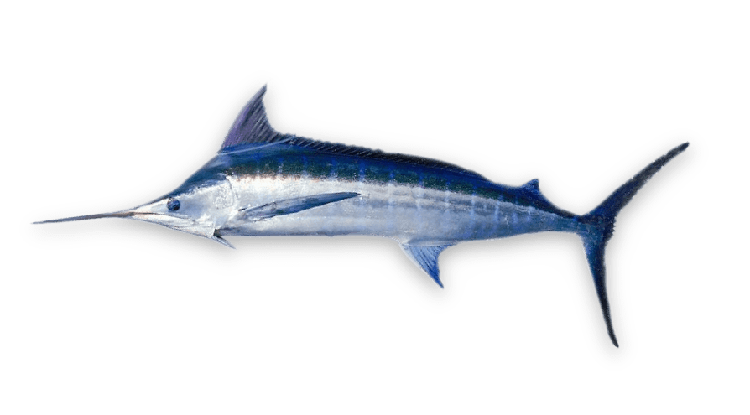
Makaira nigricans
Cuban black marlin, Ocean gar, Ocean guard
Blue marlin's bodies are cobalt blue on top shading to a silvery white on the belly. The upper jaw is elongated in the form of a spear. It has about 15 rows of pale, cobalt-coloured stripes, each of which has round dots and/or thin bars, located on both sides of the fish. The dorsal and anal fins are pointed, as opposed to the white marlin, which has rounded dorsal and anal fins. The first dorsal fin membrane is dark blue or almost black and has no dots or marks. Other fins are normally brownish-black, sometimes with a hint of dark blue. The bases of the first and second anal fins have a hint of silvery white. The lateral line is interwoven like a net, hard to see in large individuals. Blue marlin, like other billfish, can rapidly change colour, an effect created by pigment-containing iridophores and light-reflecting skin cells. The body is covered with thick, bony, elongated scales.
Blue marlin are found in blue oceanic waters. They migrate seasonally to stay in warm waters near the surface.
Blue marlin live throughout tropical and subtropical waters of the Indian, Pacific, and Atlantic Oceans.
Blue marlin are usually diurnal, solitary and migratory creatures. Unlike swordfish, blue marlin feed mostly during the day on fish and squid. They hunt alone and have been reported to use their long, sharp bill to slice or stun prey. Serious anglers rig heavy and expect to fight a marlin for 4-6 hours.
Good, may contain high mercury levels.
Trolling for blue marlin is by far the most effective way to cover water and find fish. Large-skirted lures have been the go-to blue marlin lures for decades. Skirted lures can be rigged up with hooks and trolled as lures, or they can be used as teasers in conjunction with bait. Good baits: slimy mackerel, yellowtail, or tuna (blackfin, bonito, skipjack).