Common names
Billfish, Ocean gar, Ocean guard, Atlantic sailfish, Indo-Pacific sailfish
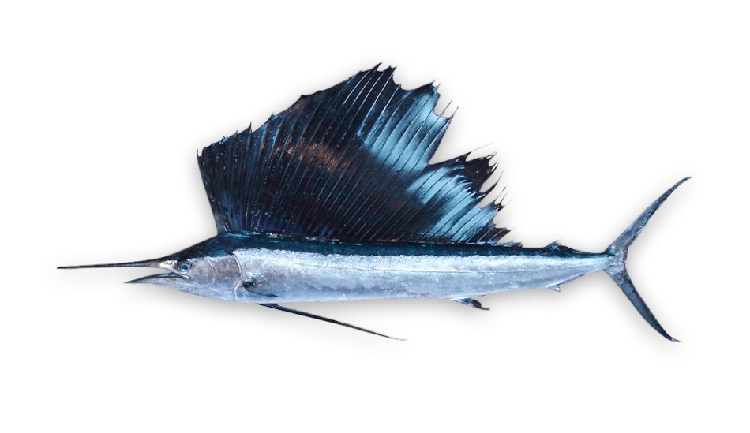
Istiophorus platypterus
Billfish, Ocean gar, Ocean guard, Atlantic sailfish, Indo-Pacific sailfish
Sailfish have a dark blue back, and are predominantly blue to grey in colour on the sides, fading to a silvery-white belly. On the sides are 15 to 20 vertical bars consisting of several small blue spots. The first dorsal fin is characteristically large and sail-like, it often stretches the entire length of the back, has black spots, is squared off in front and is highest in the middle. Their pelvic fins are extremely long and narrow, the upper jaw is elongated into a spear shape. They have embedded scales with blunt ends and their lateral line curves over the pectoral fin. Some sources indicate that sailfish are capable of changing colours as a method of confusing prey, displaying emotion, and/or communicating with other sailfish.
They are epipelagic and oceanic species, which show a strong tendency to approach continental coasts, islands and reefs in tropical and temperate waters.
Tropical and temperate waters of the Atlantic, Pacific and Indian Oceans.
They feed aggressively on fish (tunas, mackerels, halfbeaks, jacks, needlefish, herring, etc.) and squid. Sailfish have been reported to use their bills for hitting schooling fish by tapping (short-range movement) or slashing (horizontal large-range movement) at them. The sail is normally kept folded down when swimming and only raised when the sailfish attack their prey. Pods of sailfish encircle schools of fish, using their high fins to form a confining wall. One by one, the sailfish dart in to feed then return to the outer circle to wait for their next turn. Off southeast Florida (a major spawning area), sailfish move inshore to shallow water and spawn near the surface in summer. Females swim slowly with their dorsal fins above water, accompanied by one or more males when spawning. They are a highly migratory species.
Sailfish are heavy and gamy, with a slightly briny flavour depending on how you prepare them. May contain elevated mercury levels.
Troll artificial lures (soft plastics, Ilander-style lures) and rigged natural baits which skirt enticingly at the surface and offer high hook-up percentages (their soft bodies compress easily). Good baits: garfish, small tuna, blue runners, pinfish, mullet, scads, ballyhoo and squid.