Common names
Bluestripe jack, Egyptian scad, Hardtail jack, Hardnose
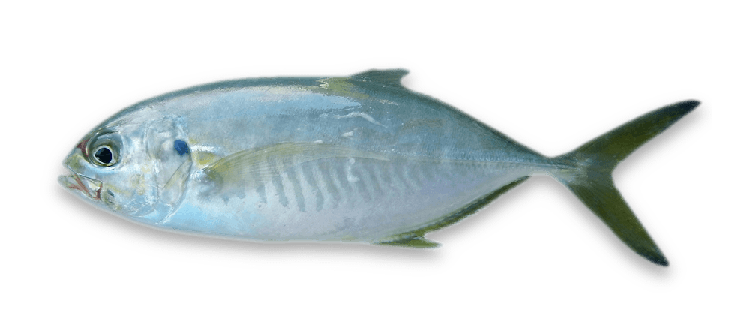
Caranx crysos
Bluestripe jack, Egyptian scad, Hardtail jack, Hardnose
Blue runner are characterized by their near football-shaped body that is mostly bluish-green to olive green on top fading to silvery grey below with a curved forked tail. A dark spot is typically present on the gill cover. Juveniles often have 7 dark vertical bands on their body. Fin colour also varies, with all fins ranging from dusky or hyaline to olive green Scutes (bone-like projections) present on the sides, in front of the tail. Tail tips are black in colour. The lateral line has a pronounced but short anterior arch, with the curved section intersecting the straight section below the spine of the second dorsal fin. The chest is completely scaled.
They are primarily inshore fish throughout most of their range, however, they are known to live on reefs in water depths greater than 100 m. Juvenile fish are also known to inhabit the shallow waters of inshore lagoons, taking refuge around mangroves or in seagrass amongst coral reef patches. Fishermen have also taken the species in the Mississippi delta, indicating it can tolerate lower salinities in almost estuarine environments.
Across the Atlantic Ocean, ranging from Brazil to Canada in the western Atlantic and from Angola to Great Britain including the Mediterranean in the east Atlantic.
The blue runner is a fast-swimming predator which primarily takes small benthic fishes as prey in inshore waters, but also feeds on shrimp and squid. Young form schools near floating objects or structures.
It is considered a fairly low-quality table fish, and larger specimens are known to carry the ciguatera toxin in their flesh.
They are both, good gamefish and baitfish, on light tackle, taking both fish baits, as well a variety of lures including hard-bodied bibbed lures, spoons, metal jigs and soft plastic jigs. Good bait: mackerel, shrimp, and squid.
Other jack species