Common names
Common jack, Black-tailed trevally, Couvalli jack, Black cavalli, Jack crevale, Yellow cavalli
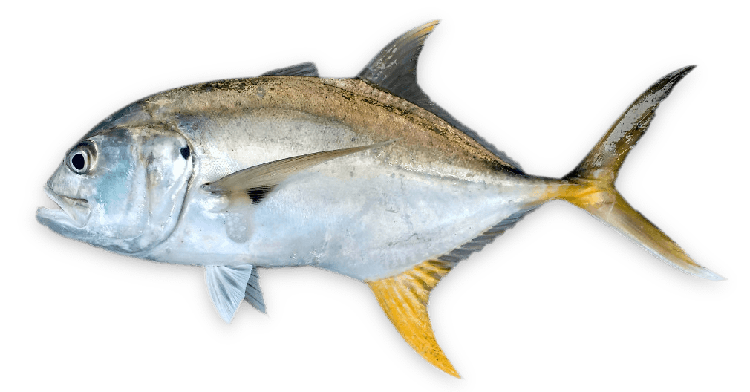
Caranx hippos
Common jack, Black-tailed trevally, Couvalli jack, Black cavalli, Jack crevale, Yellow cavalli
Crevalle jack have a body depth of about three times its fork length. Their body is elongated and moderately compressed. They have large eyes, and a scaleless chest (except for a small patch of scales in front of the pelvic fins). The back is bluish-green to greenish-gold, the belly is silver or yellowish, they have a prominent black spot on their gill covers and also a black spot at the base of each pectoral fin. The second dorsal fin and anal fin are almost identical in size. The caudal fin is strongly forked, and the pectoral fins are falcate, being longer than the length of the head. The lateral line has a pronounced and moderately long anterior arch, with the curved section intersecting the straight section midway below the second dorsal fin.
They live in both inshore and offshore habitats, with larger adults preferring deeper waters than juveniles. In the inshore environment, crevalle jack inhabit shallow flats, sandy bays, beaches, seagrass beds, shallow reef complexes and lagoons. The species is also known to enter brackish waters, with some individuals known to penetrate far upstream.
The crevalle jack inhabits the tropical and temperate waters of the Atlantic Ocean, ranging extensively along both the eastern American coastline and the western African and European coastlines.
Tolerate a wide range of salinities. The crevalle jack is a powerful, predatory fish, with extensive studies showing the species consumes a variety of small fish, with invertebrates such as prawns, shrimps, crabs, molluscs. Peak spawning occurs offshore March through September.
Crevalle jack are generally considered quite poor table fare, with a selection of younger fish and bleeding upon capture giving the best results. The flesh is very red and dark due to the red muscle of the fish, which makes it somewhat coarse and poor tasting. Large individuals may contain elevated mercury levels.
Crevalle jack readily accept any style of lure, including hard-bodied spoons, jigs, plugs and poppers, as well as flies and soft rubber lures. Good baits: live fish (mullet, menhaden), dead strip baits (fish, squid, prawns).
Other jack species