Common names
Grey tilefish, Gray tilefish, Tilefish
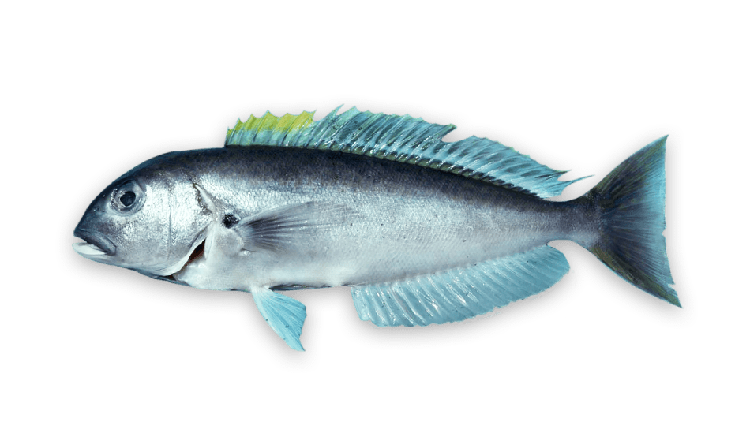
Caulolatilus microps
Grey tilefish, Gray tilefish, Tilefish
Blueline tilefish get their name from a narrow gold stripe underlined in blue that runs from their snout to the tip of their eye. They have a long snout and are a dull olive-grey on the top of their body and white on the bottom. They have long, continuous dorsal and anal fins that are more than half the length of their body and a strong, flat spine on the gill cover. Unlike golden tilefish, they do not have a large adipose flap (crest) on their head.
Individuals live at the bottom in cone-shaped burrows and concentrate in small groups or pods.
Blueline tilefish are commonly found in the western Atlantic from Campeche, Mexico, to Maine, including the eastern Gulf of Mexico.
Tilefish feed during the day on the bottom on crustaceans, clams, snails, worms, anemones and sea cucumbers. Their abundance is strongly correlated with presence of silt-clay substrate, because the soft clay enables the fish to create the burrow itself by simply digging away the clay substrate.
Blueline tilefish has a mild sweet flavour, similar to lobster or crab. It is similar in taste to golden tilefish. May contain elevated mercury levels.
While bottom rigs work just fine, "octopus" style jigs in the six to eight-ounce range work even better. Good baits: squid, sea clam, and cut fish.