Common names
Great northern tilefish, Golden tile
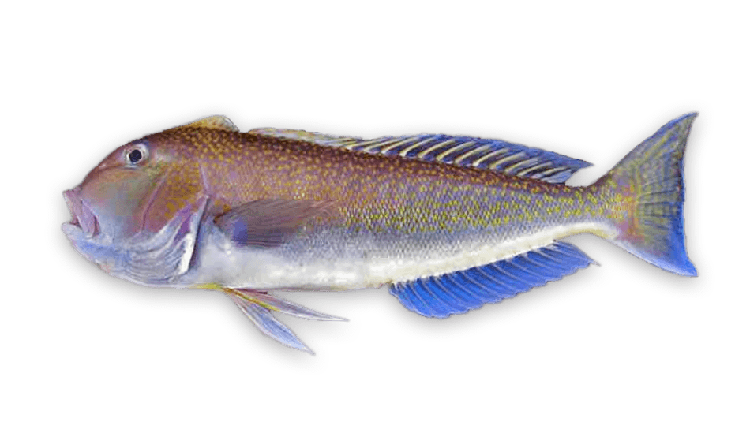
Lopholatilus chamaeleonticeps
Great northern tilefish, Golden tile
Golden tilefish's back is iridescent and blue-green in colour, with many yellow and gold spots, their bellies are white. The head colour changes from a light blue to a pinkish mix during the spawning season. Specimens have a tone of blue under their eyes. Their pectoral fins are a light tone of sepia, and the margin of the anal fin is a purplish-blue colour. Golden tilefish are easily distinguishable from other members of the tilefish family by the large adipose flap/crest on their heads. They're sometimes known as “the clown of the sea,” because of their colourfulness.
The species lives at the bottom of the ocean where they burrow into the sediment. Individuals live in cone-shaped burrows and concentrate in small groups or pods.
The species is abundant in the United States territorial waters of the Atlantic Ocean extending north into Nantucket Shoals and Georges Bank and moving south along the East Coast of the United States and into the Gulf of Mexico along the continental shelf.
Tilefish feed during the day on the bottom on crustaceans, clams, snails, worms, anemones and sea cucumbers. They've got unique burrowing behaviour and habitat preference. Their abundance is strongly correlated with the presence of silt-clay substrate because the soft clay enables the fish to create the burrow itself by simply digging away the clay substrate. The great northern tilefish is not a migratory fish; it stays in one local area that fits its needs all year round. The fish spawn during the early spring to the late fall, from March to November.
Excellent, golden tilefish is low in fat and has a delicate, sweet flavour similar to lobster or crab. May contain elevated mercury levels.
Golden Tilefish are caught on bottom rigs. Because of the great depth of water, five-pound weights are often used on the bottom rigs. The 8/0 circle hook is an ideal size hook for them. Good bait: squid and fresh-cut strip baits (bonita and barracuda).