Common names
European carp
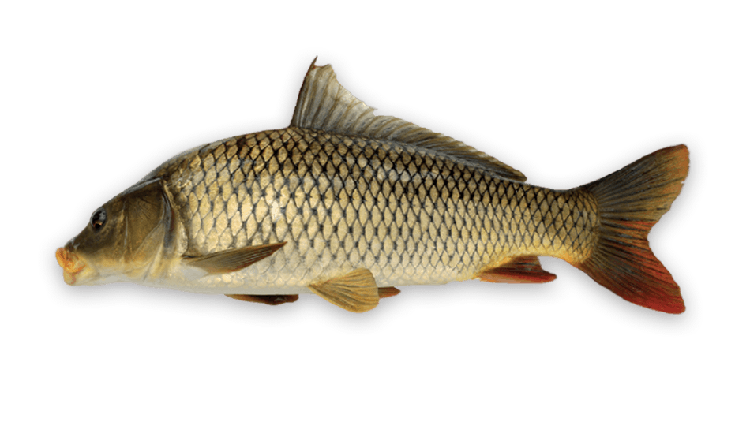
Cyprinus carpio
European carp
Common Carp are large, deep-bodied fish, typically covered with large, round scales, varying in colour from silver to olive-green, brass or grey on the back and sides. Their belly is yellowish and the lower fins are orange-red. It has a single dorsal spine and its cheeks and gill covers are partially scaled. They are heavy-bodied minnows with arched back small triangular heads tapering to blunt snouts. First ray of the dorsal and anal fins are stout, they have a serrated spine. Their small, subterminal and protrusible mouth contains no teeth, they’ve got two pairs of barbels on the upper jaw.
Although tolerant of most conditions, common carp prefer large bodies of slow or standing water and soft, vegetative sediments. Carp are able to tolerate water with very low oxygen levels, by gulping air at the surface.
Widespread worldwide freshwater fish of eutrophic waters in lakes and large rivers in Europe and Asia. Common carp have been introduced to most continents and some 59 countries. In the late 19th century, they were distributed widely throughout the country by the government as a food-fish, but they are now rarely eaten in the United States, where they are generally considered pests. As in Australia, their introduction has been shown to have negative environmental consequences.
Small groups gather in shallow, heavily vegetated areas that warm rapidly for spawning one or more males pursue a female as eggs and milt are released, but no parental care is given, the eggs sink and adhere to vegetation and debris on the bottom. As schooling fish, they prefer to be in groups of five or more. They feed by sucking up bottom silt, and selectively removing insect larvae, crustaceans, snails, and other small food items. Adult carp are omnivorous, consuming both plant and animal foods.
Are not often thought of as table fish due to their 'muddy' stigma.
Require heavy tackle, best baits include dough balls & canned corn (works best), bread crusts, and worms fished on the bottom.