Common names
Yellowbelly, Callop, Perch, Murray perch, White perch, Freshwater yellowbelly
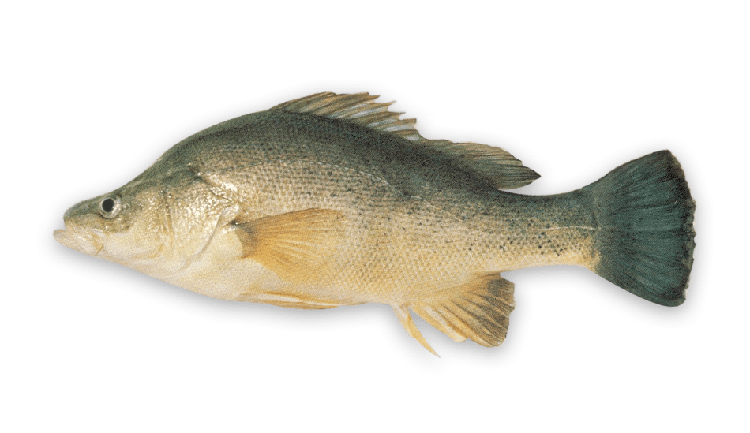
Macquaria ambigua
Yellowbelly, Callop, Perch, Murray perch, White perch, Freshwater yellowbelly
Golden perch have an elongated, deep but laterally compressed body, with a sizable mouth (lower jaw protruding slightly), small to moderate-sized eyes, a distinct curve to the forehead, and a distinct "hump" above the head. The opercula or gill covers possess a small, flat spine sharp enough to cut unwary fishermen's fingers. The caudal fin, soft dorsal fin, and anal fin are rounded. The spiny dorsal fin is short to moderate in length and strong. Golden perch vary in colour from pale silvery-gold (turbid waters) to deep yellow/gold or bronze-black (very clear waters) becoming lighter to yellow or white on the lower sides and belly. Their strong lateral line is very prominent on the rear half of the body. Pectoral fins are usually yellow, other fins vary in colour from dusky to yellowish or cream, sometimes with reddish or white edges on the lower and tail fins.
Golden perch are predominantly found in the lowland, warmer, turbid, slow-flowing rivers.
Golden perch naturally inhabit the Murray-Darling river system (except at high elevations) and exist in the internal drainage systems of Lake Eyre and the Bulloo River. Recent evidence suggests that there may be a genetic difference between populations resulting in the existence of a separate species. Golden perch have been translocated into other rivers of NSW, Queensland and the Northern Territory.
Adult golden perch are opportunistic carnivores, feeding on smaller fish and macrocrustaceans, including yabbies, shrimp, frogs, small fish, and aquatic invertebrates. Juvenile fish consume more of the smaller items such as aquatic insect larvae and microcrustaceans. Recent research in the Murray River has also suggested that some fish may move downstream to spawn. Adult and immature fish are migratory and extensive upstream movements have been recorded.
Golden perch are a good eating fish and rarely have off or muddy flavour. Any off flavour can be reduced by soaking the fillet in milk or brine water.
Spinnerbaits, hardbodies, jigs, vibes, blades and plastics all deserve their spot in the Golden perch tackle box. Spinnerbaits are the perfect casting lure with excellent accuracy. They provide a great option for casting at timber and weed beds. We recommend allowing the spinnerbait to sink to the bottom before beginning the retrieval. Good bait: small yabbies, scrub worms, earthworms, prawns, and shrimp.
Golden perch are sometimes confused with Macquarie perch (Macquaria australasica), however golden perch have a concave forehead and protruding lower jaw.