Silver perch
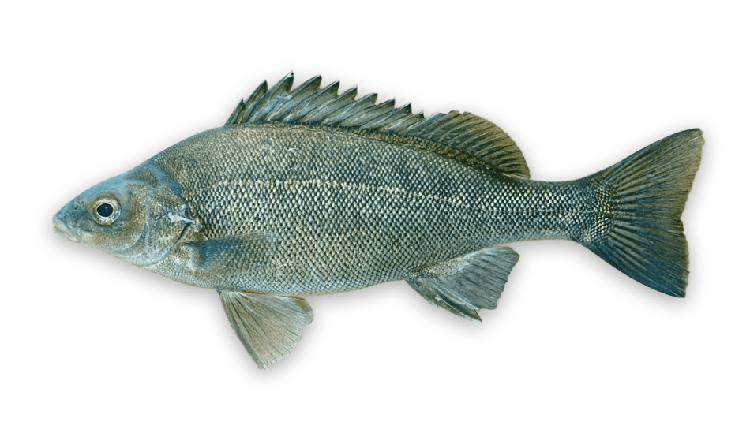
Bidyanus bidyanus
- Freshwater
- Near threatened
Max length15.75 in
Common length11.75 in
Length typeTotal Length
Max weight2 lb 3 oz
Min Depth33 ft
Water typeFreshwater
Water temperature50 - 86 °F
Fish info
Short description
Silver perch have an oval-shaped strongly compressed elongated body covered in small, thin scales that have dark margins. They have small heads (can become beak-like in larger fish) with convex dorsal profiles ending in a fairly long snout with conical teeth. Their eyes are small, the body is deepest along the lateral line and the tail is slightly forked. Large specimens become very deep-bodied with a large hump behind the head. They are usually a silver-grey colour, but vary significantly according to water turbidity, and may become a gold or greenish colour, darker on the back and paler on the sides, with a white belly. Juveniles may be mottled with vertical dark bars.
Habitat
Adults are found in rivers, lakes and reservoirs, preferring fast-flowing waters of rapids and races and usually forming aggregations near the surface. Usually found below rapids and weirs.
Distribution
Silver Perch were once widespread and abundant throughout most of the Murray-Darling river system. They have now declined to low numbers or disappeared from most of their former range. Only one remaining secure and self-sustaining population occurs in NSW in the central Murray River downstream of Yarrawonga weir, as well as several anabranches and tributaries.
Behaviour
Silver perch are opportunistic feeders, feeding on insect larvae, molluscs, annelid worms and algae. Silver perch appear primarily to be a low-order predator of small aquatic invertebrate prey, with occasional intakes of small fish and vegetative matter. They undertake long upstream migrations entirely within freshwater.
Edibility
Smaller fish are good for eating. Larger fish are better if skinned and can have a "weedy" taste.
Lure suggestion
Because of their small mouth, smaller baits and lures a best (small hard bodies and soft plastics). Flies also work very well. Good bait: freshwater shrimp & scrubworms (work best), small yabbies, and aquatic insects.
Similar species
Other similar species
Silver Perch closely resemble two other terapontid species found in adjoining drainages of the Murray-Darling system. These are the Welch's Grunter (Bidyanus welchi) and the Barcoo Grunter (Scortum barcoo).