Common names
Silvereye, white-eye, bream, black bream, Murray bream, Goulburn bream, Murray perch, mountain perch, black perch
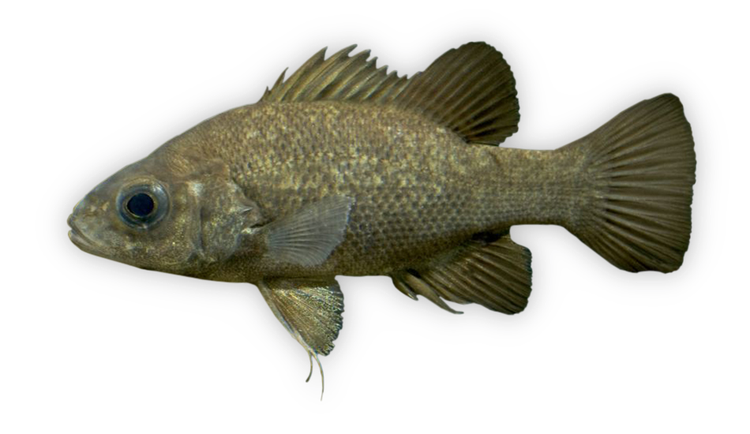
Macquaria australasica
Silvereye, white-eye, bream, black bream, Murray bream, Goulburn bream, Murray perch, mountain perch, black perch
Macquire perch have a tapered snout with upper and lower jaws of equal length. They have conspicuous pores on the lower jaw. Their body is elongated, deep, and laterally compressed. The caudal fin, anal fin and soft dorsal fin are rounded. Their back colouration varies from black or dark silvery-grey, dark brown to dark grey, bluish-grey or green-brown on the upper body. Sides are lighter, belly is usually paler to off-white, often with a bronze or yellowish tinge. Pectoral fins are grey to yellowish. Pelvic fins are often rosy with black edges, and other fins are generally greyish, often with a purplish tinge. Juvenile fish are often mottled on the back and sides. The second spine in the anal fin is the longest.
Naturally, a riverine fish (originally found in the larger upland rivers and streams), prefer deep holes.
Occur naturally north of the Great Dividing Range in tributaries of the Murray-Darling system. Introduced to a number of waters south of the Divide, but now persisting as self-supporting populations only in the Yarra River and Wannon River.
Carnivorous, taking its food by a sucking motion, principal diet items being aquatic insects with some crustaceans and molluscs.
Excellent eating, similar to smaller-sized golden perch, but very boney.
Will take most diving hard body lures along with spin lures, they can however be difficult to catch on lures as they prefer to travel and feed at the sides of the water rather than in the middle where the faster flow occurs. Getting a lure travelling along the bottom of the river bed near the bank is often the best way to catch them. Good bait: scrub worms, yabbies and maggots.