Common names
Devil firefish
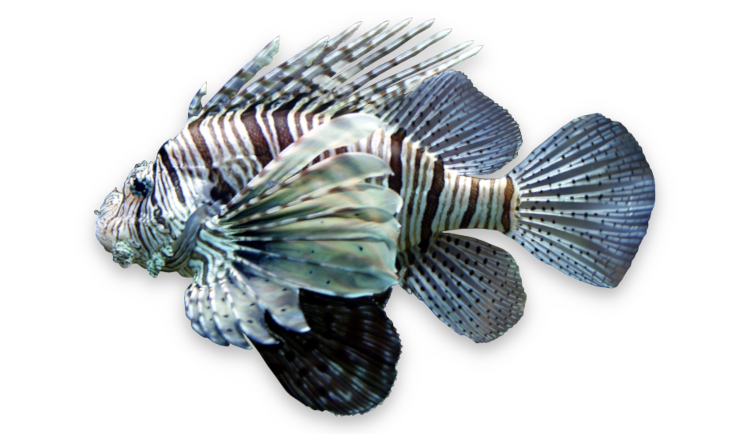
Pterois miles
Devil firefish
The dorsal fin of the common lionfish features 13 long, strong spines and 9-11 soft rays, while the anal fin has 3 long spines and 6-7 soft rays. Their dorsal fin appears feathery, and the pectoral fins are wing-like, with broad, smooth rays. These fish vary in colour from reddish to tan or grey and have numerous thin, dark vertical bars on their heads and bodies. Their head is less angular compared to the red lionfish. Adults also have a band of small spines along their cheeks and small spots on their median fins. Additionally, the tentacle above the eye may be faintly banded.
Usually found in areas with crevices or lagoons, often on the outer slopes of coral reefs.
Indian Ocean, including the Persian Gulf and the Red Sea, extending south to Port Alfred, South Africa, and east to Sumatra, Indonesia. It has also been introduced to the western Atlantic, found along the east coast of the United States and in the Caribbean Sea. Additionally, it is known to occur in the eastern Mediterranean.
The common lionfish is primarily nocturnal, spending the daytime hiding in crevices. They prey on fish and small crustaceans. Due to its venomous spines, it has few natural predators, although larger lionfish may prey on smaller individuals.
Considered a popular table fish with firm, white, flaky flesh. They have a pleasantly mild, slightly buttery flavor and a moderately firm texture. Once the venomous spines are carefully removed, lionfish can be prepared like any other high-quality eating fish.
Lionfish are rarely caught on hook-and-line. The most effective methods for capturing them are spearing or using a hand-held net. Extreme caution is advised during handling to avoid their venomous spines located on the dorsal, pelvic, and anal fins.