Common names
Butterfly Cod, Firefish, Lionfish, Ornate Butterfly Cod, Peacock Lionfish, Red Firefish, Turkeyfish, Zebrafish
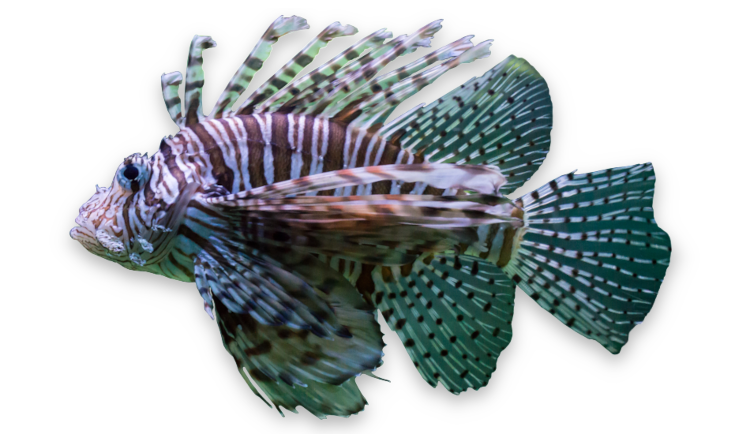
Pterois volitans
Butterfly Cod, Firefish, Lionfish, Ornate Butterfly Cod, Peacock Lionfish, Red Firefish, Turkeyfish, Zebrafish
Red lionfish are characterized by their striking white stripes alternating with red, maroon, or brown stripes. They possess large, venomous spines on their dorsal fin (13), along with venomous spines on their pelvic fins (2) and anal fins (3). These venomous spines, combined with their long, flowing non-venomous fins, create a mane-like appearance, earning them the common name "lionfish." The dorsal spines serve as a strong deterrent to most potential predators. No definitive natural predators of lionfish have been identified, leading many organizations to encourage their harvest and consumption as a means of controlling their rapidly growing populations.
They inhabit lagoons and seaward reefs from turbid inshore areas to depths of 50m.
Red lionfish are native to the Pacific Ocean, ranging from the Cocos-Keeling Islands and Western Australia in the eastern Indian Ocean to the Marquesas and Oeno (Pitcairn group). Their range extends north to southern Japan and southern Korea, and south to Lord Howe Island, northern New Zealand, and the Austral Islands. However, they have been introduced to the Atlantic, where they have spread from North Carolina to South America, including the Gulf of Mexico & the Caribbean.
They are often solitary creatures, typically hiding in secluded areas during the day, remaining nearly immobile and often positioning their heads downward. Pelagic juveniles travel vast distances, contributing to the species’ wide geographical range. At night, they actively hunt small fish, shrimp, and crabs, using their wide pectoral fins to trap prey in corners, stun them, and consume them in a single motion. Lionfish reproduce monthly and have a larval stage that allows them to disperse quickly, aiding in the expansion of their invasive range.
Considered a popular table fish with firm, white, flaky flesh. They have a pleasantly mild, slightly buttery flavor and a moderately firm texture. Once the venomous spines are carefully removed, lionfish can be prepared like any other high-quality eating fish.
Lionfish are rarely caught on hook-and-line. The most effective methods for capturing them are spearing or using a hand-held net. Extreme caution is advised during handling to avoid their venomous spines located on the dorsal, pelvic, and anal fins.