Common names
Australian Shovelnose Ray, Banjo Fish, Banks Shovelnosed Ray, Bank's Shovelnosed Ray, Bank's Shovelnosed-ray, Common Shovelnosed Ray, Eragoni, Guitarfish, Long-snout Shovelnose Ray, Shovelnose Ray, Shovelnose Shark, Shovel-nosed Ray, Southern Shovelnose Ray, Fiddler shark
IUCN Vulnerability status
Least concernShort description
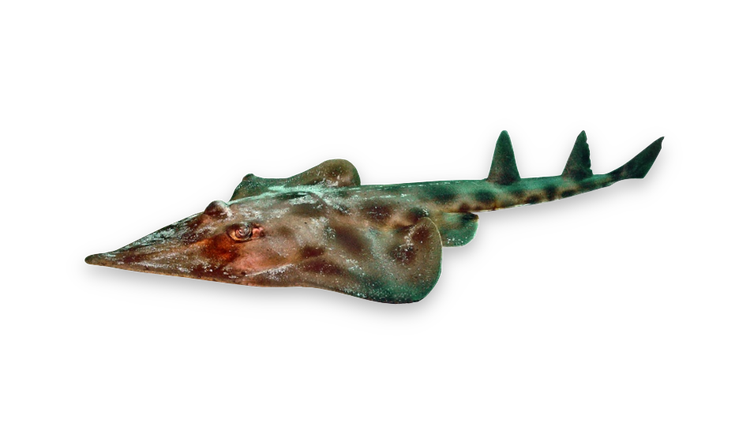
Eastern Shovelnose Ray are small to medium-sized guitarfish with a flat, wedge-shaped disc and an elongated snout. Their body features two dorsal fins of roughly equal size on top of a broad tail. The colouration of this species is typically sandy or brownish, with dark patches on its body, a blackish tip on the snout, bold orange patches in front of the eyes, and a pale underside with dark flecks. Its eyes are positioned on the dorsal surface. The species is known for its long, flattened triangular snout, wedge-shaped disc, and shark-like tail. Males of this species have a more pronounced lower jaw, longer and sharper teeth, and stronger jaw muscles, which help them grip the female's fin during mating. The specific name "rostrata" is derived from the Latin term meaning "beaked," referring to the species' elongated snout.
Habitat
They inhabit sandflats, mudflats and seagrass beds in bays, estuaries, river mouths, around rocky reefs and in surf zones, at depths of about 100 m.
Distribution
Endemic to subtropical and temperate waters of eastern Australia, from north of Eagle Reef, Great Barrier Reef, Queensland, to Mallacoota, Victoria.
Behaviour
This ray feeds on a variety of fishes and benthic invertebrates, such as prawns, shrimps, crabs, stomatopods, and molluscs. As a suction-crushing feeder, its teeth are specially adapted to grind its hard-bodied prey. The species follows a distinct annual and seasonal reproductive cycle, mating during the winter months and giving birth to pups in the summer.
Edibility
Has a mild flavour, low oiliness and moderately moist, firm flesh, which is generally boneless pairing well with butter, capers, citrus, and rosemary. Although depending on the cut some cartilage, which will soften with cooking, may remain. Flesh has good gelling characteristics and works well minced for fish cakes and fish balls. The flesh is highly regarded in Asia and the fins are often used in shark fin soup. The firm flesh holds together well in soups, curries and casseroles and can be cubed for kebabs.
Lure suggestion
Caught mainly as bycatch of demersal trawlers but also by seine and gillnets. Recreational fishermen often catch them, and sometimes kill them to avoid catching them again. Surfcasting is an effective technique anglers use to target eastern shovelnose rays.
Good bait: Herring (fillets or live).