Common names
Banjo Ray, Banjo Shark, Dumeril's Shovelnose-ray, Fiddler, Fiddler Ray, Green Skate, Magpie Fiddler Ray, Magpie Ray, Paritt, Parrit, Southern Fiddler
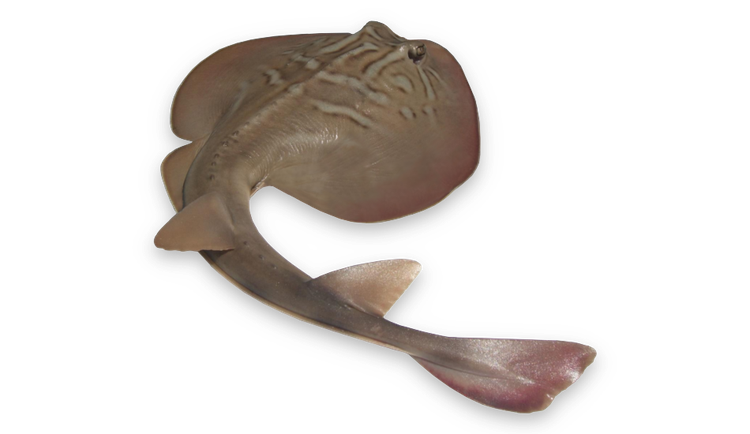
Trygonorrhina dumerilii
Banjo Ray, Banjo Shark, Dumeril's Shovelnose-ray, Fiddler, Fiddler Ray, Green Skate, Magpie Fiddler Ray, Magpie Ray, Paritt, Parrit, Southern Fiddler
A large yellowish to brownish fiddler ray with a flattened, oval to diamond-shaped disc and a broadly rounded snout. It features a pattern of dark-edged greyish bands radiating from the eyes and back, without a distinct triangular or diamond-shaped marking behind the eyes. The body has a row of large thorn-like denticles along the middle of the disc to the first dorsal fin, a long broad tail with two similar-sized dorsal fins, and a well-developed upper tail lobe with a shorter lower lobe. The jaws are equipped with numerous small, blunt crushing teeth. Some individuals from regions like Gulf St Vincent, Kangaroo Island (South Australia), and Port Phillip (Victoria) display a mottled dark-brown to a black-and-white colour pattern, previously thought to be a separate species, but later identified as colour morphs of the southern fiddler ray through genetic studies.
They inhabit sandy areas and seagrass beds, occasionally entering estuaries.
Widespread in southern Australia to southern New South Wales, including northern Tasmania. The species is rare in New South Wales.
Southern fiddler rays often forage on sandflats and in seagrass beds - feeding on crustaceans (crabs, shrimps), small fishes, molluscs and polychaete worms. They crush hard-shelled prey such as crabs and molluscs with the small blunt teeth in their powerful jaws. Small juveniles feed mostly on small crustaceans, including amphipods, isopods and mysid shrimps.
These rays are edible and meat is similar in taste to gummy shark. Most fishers choose to release these rays as to prepare them requires some effort for a small meat return.
Southern Fiddler Rays are usually caught as bycatch rather than being specifically targeted. They are commonly caught in the Great Australian Bight trawl fishery and in southeastern Australia using Danish seines, shark hooks, and net fisheries. Although catches are relatively low, the species is often discarded alive due to its high post-release survival rate. Anglers may encounter them while targeting other species like flathead or gummy sharks. When handling, take care to avoid the small sharp spines along the back.
Eastern fiddler ray