Common names
Brackish Water Perch, Estuarine Perch, Gippsland Perch, Perch
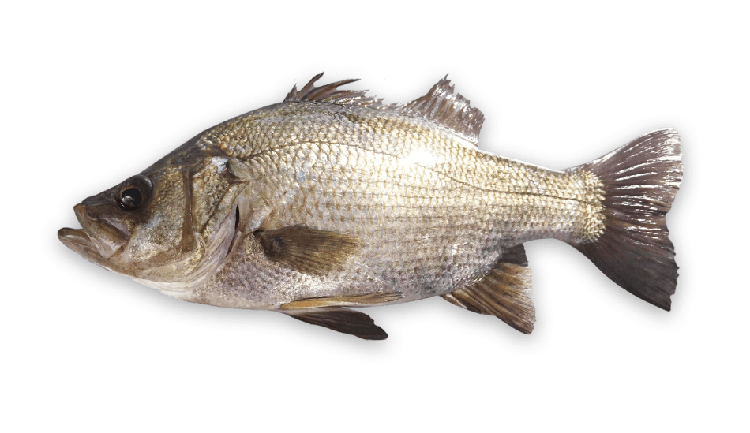
Macquaria colonorum
Brackish Water Perch, Estuarine Perch, Gippsland Perch, Perch
Estuary perch are very similar to and very closely related to their sister species, the Australian bass. The body of an Estuary Perch is slightly deeper than that of the Australian Bass, the snout profile is concave and the tapered snout is noticeably longer than that of the Australian Bass. The Estuary Perch is a dark grey or olive-green to silvery on the back becoming paler below and on the sides. Sometimes have purplish or reddish tints on the head. All fins are dark-coloured, often with a greenish tinge. They have a forked tail, moderately large eyes, and an oblique mouth, with the gape reaching below the middle of the eye. They are covered by moderate scales, which are also on the cheeks and gill covers. Estuary perch have a prominent lateral line
It prefers brackish waters such as lower tidal reaches of coastal lakes, rivers, and streams.
The Estuary Perch lives in coastal rivers and lakes in an area from the Richmond River (NSW) in the north, to the Murray River (South Australia) in the west and as far south as the Arthur and Ansons Rivers (Tasmania).
Estuary perch breed in winter at the same time as Australian bass, and are similarly sexually dimorphic, with females larger than males. Females reach sexual maturity at older ages and larger sizes than males. In Victoria, estuary perch/Australian bass hybrids are regularly recorded, and most hybrids appear to be reproductively viable.
Their eating quality (flavour and texture) is superb.
Responds well to artificial flies and lures. Soft plastic style lures on heavy 1/8oz jigheads work a treat with 2.5 grubs and 2.5 minnows that are perfect for the job. They also respond well to small (30-40mm) metal vibration baits. Good bait: insects (black crickets), small fish (minnows, etc.), crustaceans and worms.
Looks very similar to Australian Bass (Macquaria novemaculeata) which can be distinguished from the Estuary Perch by their straight dorsal head profile.