Common names
Muskie, Musky, Ski, Lunge
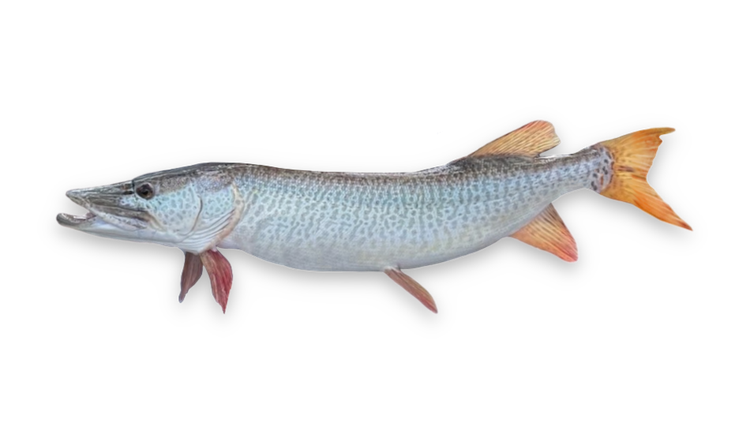
Esox masquinongy
Muskie, Musky, Ski, Lunge
Muskellunge are classic ambush predators with long, streamlined bodies and a flat, wide head. Their dorsal, pelvic, and anal fins sit far back on the body, allowing for explosive bursts of speed when striking prey. Coloration varies from silver to brown or green, usually with dark vertical bars along the sides that can sometimes break into spots. In murky water, these markings may be faint or completely absent. Muskies are often confused with northern pike, but there are a few clear differences. Muskies typically have sharper-pointed tail fin lobes, fewer scales on the lower part of the gill cover, and more sensory pores under the lower jaw. Overall, they tend to appear lighter in color than pike, with darker markings instead of light ones.
Muskellunge prefer clear, vegetation-rich lakes, as well as slow-moving sections of rivers, backwaters, and quiet pools. They are often found near weed edges, submerged timber, and structure that provides cover for ambush hunting.
Muskellunge are native to North America, primarily within the Great Lakes, St. Lawrence River, Hudson Bay (Red River), and Mississippi River basins. They have been introduced to other waters across the United States, with some native populations receiving special protection in certain regions.
Muskies are solitary, highly territorial predators that rely on stealth and surprise. They primarily feed on other fish but are also known to eat ducklings, muskrats, snakes, and other small animals that venture into the water. As apex predators, they consume larger prey than most freshwater fish and can swallow meals up to two-thirds of their own length thanks to their large stomachs. Muskies strike quickly, seize prey with powerful jaws, and swallow it headfirst. Spawning occurs in mid- to late spring, slightly later than northern pike, in shallow, vegetated areas with sandy or rocky bottoms. While extremely rare, occasional attack on humans have been recorded.
Muskellunge have firm, white flesh with a mild, slightly sweet flavor, similar to northern pike or walleye. While considered good eating by some anglers, they contain many fine bones and require careful preparation to cook properly.
Muskies are famously known as the “fish of 10,000 casts,” reflecting their cautious nature and selective feeding behavior. Success often depends on timing, with feeding windows influenced by water conditions, weather patterns, and even lunar phases. Large in-line spinners, commonly called bucktails, are a staple muskie lure and can be effective throughout much of the season. Diving plugs in the 6–10 inch range also work well, especially in deeper or less weedy areas. Glide baits with wide, side-to-side action are excellent for triggering reaction strikes, while soft-plastic swimbaits allow anglers to target any depth. Topwater lures are particularly exciting, as muskies can rise to the surface to attack with explosive force.
Tiger muskellunge