Common names
Pike, Water wolf, Common pike, Snake, American pike, Jackfish, Great Lakes pike, Grass pike, Pickerel, Longhead, Snot rocket, Great northern pike
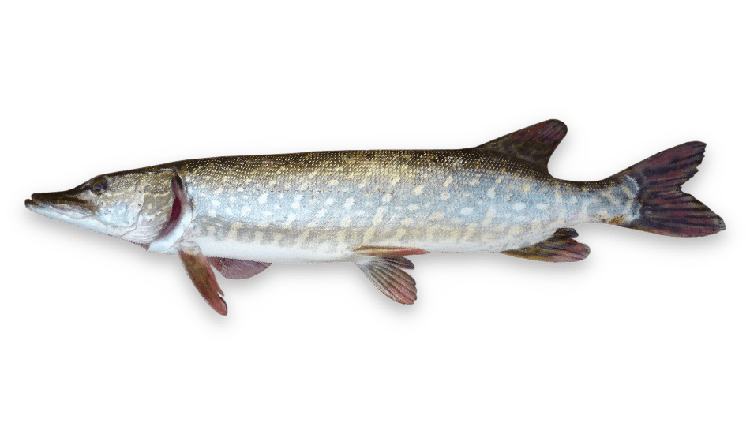
Esox lucius
Pike, Water wolf, Common pike, Snake, American pike, Jackfish, Great Lakes pike, Grass pike, Pickerel, Longhead, Snot rocket, Great northern pike
Northern Pike have an elongated body and a grey-to-greenish colour that fades to a yellowish-white belly. They have distinctive uneven rows of yellowish-to-white specks that run across its body. Sometimes, the fins are reddish. Younger pike have yellow stripes along a green body; later, the stripes divide into light spots and the body turns from green to olive green. The lower half of the gill cover lacks scales, and it has large sensory pores on its head and on the underside of its lower jaw which are part of the lateral line system. Unlike the similar-looking and closely related muskellunge, the northern pike has light markings on a dark body background and fewer than six sensory pores on the underside of each side of the lower jaw.
Pike are found in sluggish streams and shallow, weedy places in lakes and reservoirs, as well as in cold, clear, rocky waters.
North America: Atlantic, Arctic, Pacific, Great Lakes, and Mississippi River basins from Labrador to Alaska and south to Pennsylvania and Nebraska, USA. Eurasia: Caspian, Black, Baltic, White, Barents, Arctic, North and Aral Seas and Atlantic basins, southwest to Adour drainage; Mediterranean basin in Rhône drainage and northern Italy. Widely distributed in central Asia and Siberia eastward to Anadyr drainage (Bering Sea basin). Historically absent from Iberian Peninsula, Mediterranean France, central Italy, southern and western Greece, eastern Adriatic basin, Iceland, western Norway and northern Scotland.
Northern Pike are popular freshwater gamefish known for their greedy carnivorous nature. Pike are aggressive if not given enough space because they are territorial. They use a form of foraging known as ambush foraging. Pike undergo bursts of energy instead of actively chasing down prey. As such, a fair amount of inactive time occurs until they find prey. Pike have strong homing behaviour and during the summer, they tend to group closer to vegetation than during the winter.
They have great-tasting meat that you can cook in many different ways. Another reason to have pike is its various nutritional benefits. As one of the healthiest cool-water fishes, they make a great choice for those who like to follow a healthy diet.
The very best lures to use for pike in clear water are swimbaits, softbaits, and crankbaits with an authentic pattern and swimming action. Natural lure colours that resemble the pike’s prey, such as white, silver, green, or black, have proven most effective. Artificial lures actually work better and offer more benefits for pike fishermen than live bait. Good bait: baitfish like ciscos, suckers, alewives, and shad along with yellow perch and bluegill.
Muskellunge, Grass pickerel, Redfin pickerel, Amur pike, Southern pike, Aquitanian pike, Tiger muskellunge