IUCN Vulnerability status
is considered to be threatened with global extinction
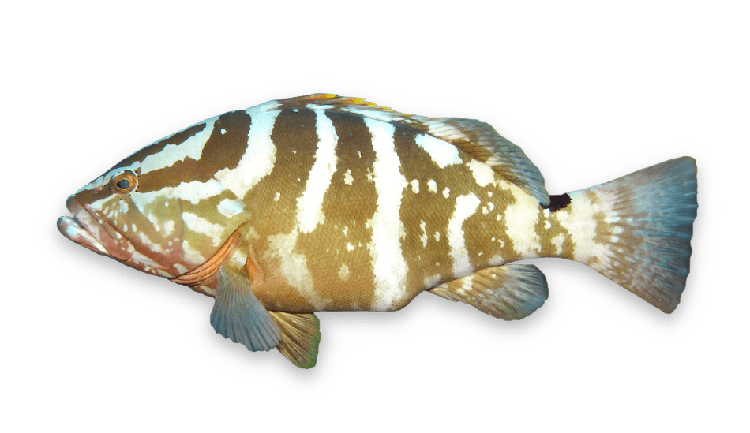
Epinephelus striatus
is considered to be threatened with global extinction
Nassau grouper have a thick body and large mouth, which they use to "inhale" prey. Their colour varies depending on an individual fish's circumstances and environment. In shallow water (down to 60 ft/18,3 m), the grouper is a tawny colour, but specimens living in deeper waters are pinkish or red, or sometimes orange-red in colour. Superimposed on this base colour are a number of lighter stripes, darker spots, bars, and patterns, including black spots below and behind the eye. A dark band forms a tuning fork pattern on top of the head, beginning at the front of the upper jaw, extending through each eye, and then curving to meet its corresponding band in front of the dorsal fin. Colour patterns can change within minutes from almost white to bicoloured to uniformly dark brown, according to the behavioural state of the fish. A distinctive bicolour pattern appears when two adults or an adult and a large juvenile meet and is often seen at spawning aggregations. The third spine of the dorsal fin is longer than the second spine, the pelvic fins are shorter than the pectoral fins.
The Nassau grouper lives in the sea near reefs. They are one of the largest fish to be found around coral reefs. As juveniles, they are found in nearshore shallow waters in macroalgal and seagrass habitats. They shift deeper as they grow, to predominantly reef habitats (forereef and reef crest).
They live in the western Atlantic Ocean, from Bermuda, Florida, and the Bahamas in the north to southern Brazil, but it is only found in a few places in the Gulf of Mexico.
Form large spawning aggregations annually, making this species highly vulnerable to overharvesting. Nassau grouper are ambush predators that are not selective with their prey. They swallow prey whole using a suction created by their protruding mouth. Their mouth size determines the size of the fish they eat. Adults eat only fish, while juveniles eat a variety of fish and invertebrates (e.g., shrimp and crabs).
The Nassau grouper is one of the most popular dishes in the Bahamas. Their meat is lean and succulent with large flakes and a firm texture. There have been reports of ciguatera poisoning from human consumption of this fish.
Only general for groupers, because harvesting Nassau grouper is PROHIBITED: The best lures for grouper fishing are heavy like a large standard jig with a soft plastic trailer or a jigging spoon that drops to the bottom quickly. The action of bottom bouncing or jigging can trigger a reaction bite. They are also caught by trolling plugs or spinners. Good bait: squid, chub mackerel, sardine, white crab, shrimp or octopus pieces. (normally not picky)
Red grouper, E. morio (has tiny dark spots near eyes)