Common names
Grouper, Cherna americana, Negre
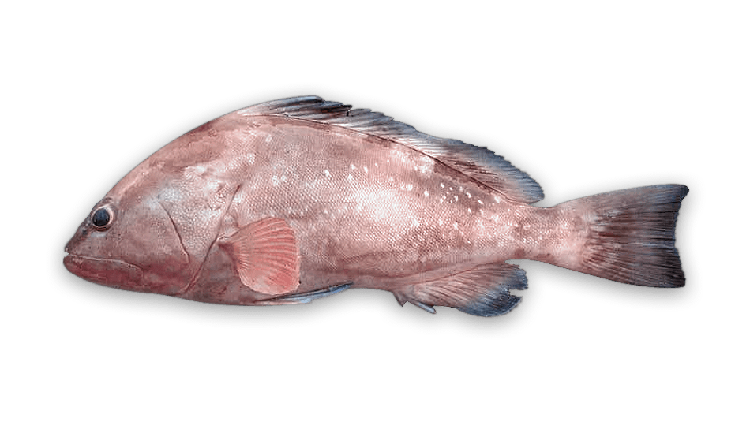
Epinephelus morio
Grouper, Cherna americana, Negre
Red grouper have robust bodies with small scales. They are dark reddish brown on the upper part of the head and body, shading to a paler pink on the underparts, they are marked with lighter spots and blotches across their body and there are darker margins to the fins. They have tiny black dots on their snouts, their mouth is lined in scarlet-orange colour. The gill cover has three flat spines with the central spine being the longest. The pectoral fins are longer than the pelvic fins and the caudal fin is truncate. The second spine of the dorsal fin is long. They have large mouths with a lower jaw that often projects slightly beyond their upper jaw, with bands of slender, sharp teeth, and usually a few stout, fixed canines. Their large mouths allow them to eat their prey whole.
Bottom-dwelling fish found over hard and muddy bottoms. Juveniles and young adults occupy nearshore reefs, they move offshore as they mature.
Red grouper are found in the western Atlantic Ocean from Massachusetts through the Gulf of Mexico and south to Brazil.
Spawning occurs offshore between January and June, peaking in May. While primarily eating benthic invertebrates, the red grouper is an opportunistic feeder in the reef community. The diet commonly includes crabs, juvenile spiny lobster, and snapping shrimp, with the occasional fish. Like many other grouper, red grouper undergo a sex reversal, with young individual females becoming males as they age. Red grouper actively excavate pits in the seafloor. They use their caudal fin and their mouths to remove debris and sediment from rocks, creating exposed surfaces on which sessile organisms actively settle (e.g., sponges, soft corals, algae).
Excellent, low in saturated fat, and a good source of vitamins B, phosphorus, potassium, protein, and selenium. Large individuals may contain ciguatera toxin and elevated mercury levels.
Red grouper can be caught by fishing baits or jigs near or along the bottom using a bouncing technique. Other methods for catching red grouper include drift fishing and jigging. The best lures to use for red grouper are jerkbaits and jigs, however, crankbaits, especially those that imitate shrimp, can bring you nice results as well. Good bait: octopus, squid, crab, shrimp and smaller fish.
Nassau grouper, E. striatus (large black spot on caudal peduncle)