Common names
Convict fish
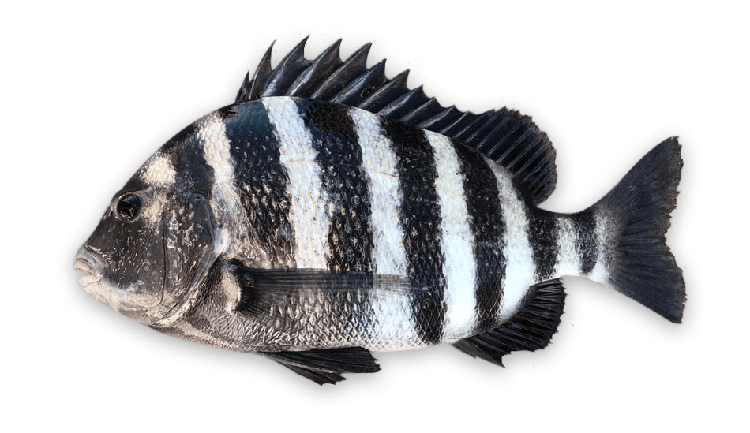
Archosargus probatocephalus
Convict fish
Sheepshead have an oval, deep, laterally compressed body, a sharp gill cover and strong sharp dorsal and anal spines. The second spine of the anal fin is enlarged. Pectoral fins are long, extending beyond the anal opening when appressed (pressed close to the body). The caudal fin is shallowly forked. They have a blunt snout and small, nearly horizontal mouth. The posterior nostril is slit-like in appearance. They have a hard mouth and prominent several rowed (human-like) teeth with incisors, molars and rounded grinders that enable them to crush shellfish and sea urchins. They have got no barbels on their lower jaw. Their body has a grey-coloured background with five or six vertical black bars on the sides. The caudal and pectoral fins are greenish while the dorsal, anal, and ventral fins are dusky or black. Vivid black and white bars make the sheepshead or "convict fish" distinctive among fishes.
Coastal waters near structures such as oyster bars, seawalls, piers, bridges and tidal creeks. They move nearshore during late winter and early spring for spawning.
Along the western Atlantic, from Nova Scotia to Brazil, but the greatest concentration is around southwest Florida.
Fractional spawners (they only lay a portion of their eggs at a time) in inshore waters, typically in March and April. They are omnivorous feeding mostly on crustaceans and small fish.
Very good, they have a shellfish flavour that is both sweet and tasty. They have delicate white flesh and a delicious mild flavour, but their tough scales and strong fin spines make this species difficult to clean or fillet.
Use light tackle, let the bait hit the bottom, and then slowly bring the bait up in 1-foot increments. Consider a shrimp-tipped jig. The heavier weight helps keep the bait down and from being dragged with the current. Sheepshead are known for stealing bait, so a small hook is necessary. Good bait: small fiddler and hermit crabs (work best), shrimp, mollusks, minnows, clams, or squid.
Black drum, P. cromis (has chin barbels and lacks incisor-like teeth), Atlantic spadefish, C. faber (lacks incisor-like teeth)