Common names
Flounder, Fluke, Northern fluke, Hirame
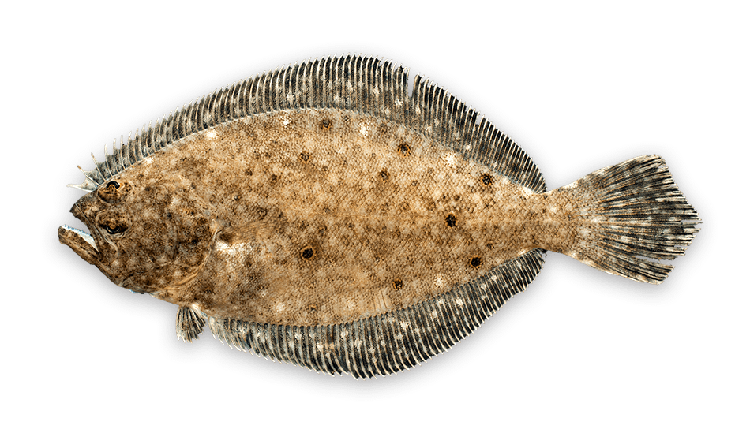
Paralichthys dentatus
Flounder, Fluke, Northern fluke, Hirame
Summer flounder have flat bodies. They are bottom-oriented left-eyed flatfish (both eyes are on the left side of its body when viewed from above with the dorsal fin facing up). When larvae develop into juveniles, their right eye moves across the top of the head to the left side. They are white below and some shade of brown, grey, or drab above. They’re nicknamed “chameleons of the sea” because they’re able to change their colouring to blend in with the texture and colour of the bottom where they live. They have several ocellated or eyelike spots on the body, at least five of which are arranged in an "X" pattern. The teeth are quite sharp and well-developed on both the upper and lower jaws. They also have a wedge-shaped tail, with its tip in the middle.
Inshore (beaches, inlets, bays, estuaries, canals, and creeks) and offshore waters on or close to the ocean floor buried in sandy substrate.
Summer flounder are found in the Atlantic Ocean from Nova Scotia to the east coast of Florida. In U.S. waters, summer flounder are most common in the mid-Atlantic region from Cape Cod, Massachusetts, to Cape Fear, North Carolina.
Their right eye migrates over to the left side early in life. Bottom-dwellers, which spawn offshore. They feed primarily on small fish and crustaceans (shrimp, crabs). While primarily considered bottom fish, they are rapid swimmers over short distances and can become very aggressive, feeding actively at mid-depths, even chasing prey to the surface. In the spring months, they leave their winter stay in the deep ocean waters, where spawning occurs, to move into inshore waters, where they will stay until autumn or even early winter.
Excellent, they have very delicate white flesh, mild taste and texture. Many people prefer eating it because it lacks a fishy taste.
Live or cut baits on a bottom rig, artificial lures such as swimming mullets and spinnerbaits, or weighted jigs tipped with strip baits. It is recommended that you use a circle hook because it is easier for flounders to bite. Good bait: live bait (minnow, croaker, mullet), strip baits (bluefish, croaker, etc.), squid, sea worms, or clams.
Gulf flounder, P. albigutta (has only three prominent eyelike spots), Southern flounder, P. lethostigma (may have 5 or more spots but they are not eyelike)