Common names
Molly, Redeye, Goggle-eye, Red-eyed bream, Strawberry perch
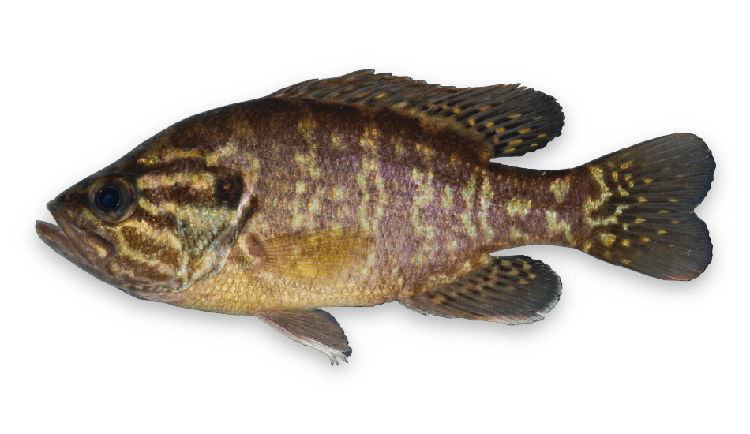
Lepomis gulosus
Molly, Redeye, Goggle-eye, Red-eyed bream, Strawberry perch
Warmouths are robust sunfish with a stockier build when compared to others in the sunfish family. The adult warmouth is dark, with a mottled brown coloration. Its belly is generally golden, and the male has a bright-orange spot at the base of the dorsal fin. Three to five reddish-brown streaks radiate from the eyes, and the gill flaps are often red. The warmouth is occasionally confused with the rock bass or green sunfish, both of which share its relatively large mouth and heavy body. Warmouths have teeth on their tongues, which are also absent in rock bass and green sunfish.
They can live in ponds, lakes, rivers, and backwater streams and can often survive in streams with low oxygen levels where other species of sunfish cannot. Warmouth occupies areas with ample vegetation as cover with slower-moving water, often around stumps, brush piles, and other dense entanglements that allow the warmouth the ability to ambush prey, yet escape larger predators that may threaten them.
North America: Great Lakes and Mississippi River basins from western Pennsylvania to Minnesota in the USA, and south to the Gulf of Mexico; Atlantic and Gulf drainages from Rappahannock River in Virginia to Rio Grande in Texas and New Mexico, USA.
The primary diet of the warmouth consists of insects, crayfish, and other fish. The primary diet of young warmouth is microcrustaceans and aquatic insect larvae, whereas larger specimens tend to mainly consume crayfish, freshwater shrimp, isopods, and other small fish. Spawning for the warmouth begins usually begins when water temperatures reach 21.1 °C (70.0 °F). Their spawning often begins in May and lasts until July. Nests are primarily constructed on rock or gravel substrates, usually located in or near to some type of structure in the water column.
They are good to eat when caught in clean water, but because they are bottom-feeders like catfish, the flesh can have a strong flavour.
Most anglers simply use a pole and worm to hook these fish. They can also be caught by bait casting or spin casting. Look for them in shallow areas with plentiful vegetation or near fallen stumps. Warmouths can be caught with both baits and lures. Most anglers use worms or spinners. Good bait: red worms (best), pastes, flag worms, wasps, gentles, green flies, butter flies, and a grasshopper with his legs cut off.