Common names
Rock perch, Red eye, Goggle-eye, Black perch
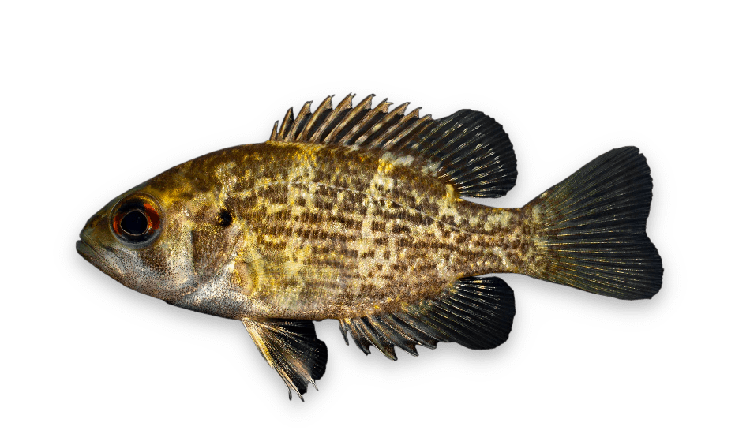
Ambloplites rupestris
Rock perch, Red eye, Goggle-eye, Black perch
Rock bass' colourations vary from golden brown to olive with white to silver highlights on the belly and rows of dark dots on their sides. They possess the ability to rapidly change their colour to match their surroundings. This chameleon-like trait allows them to thrive throughout their wide range. Often the species has red to orangish eyes, resulting in the name red eye. There is a black spot at the edge of the gill cover and the mouth of the rock bass is larger and more “bass-like” than in most small sunfishes. The rock bass is a large and robust sunfish that looks like a cross between a bluegill and one of the black basses. Identifying characteristics of rock bass are their two dorsal fins that have spinous and soft-rayed united portions, a large mouth and six anal spines.
Rock bass prefer clear, rocky, and vegetated stream pools and lake margins. Rocky banks of northeastern lakes and reservoirs are a common habitat for rock bass. Their favourite habitat contains some vegetation with rocky bottoms and cool to warm waters. Rock bass species are usually found near rocky shorelines. They can be surprisingly unflustered by the presence of human activity, living under lakeside docks and near swimming areas. Rock bass are frequently seen in groups, particularly near other sunfish.
Rock bass are native to the St Lawrence River and Great Lakes system, the upper and middle Mississippi River basin in North America from Québec to Saskatchewan in the north down to Missouri and Arkansas, south to the Savannah River, and throughout the eastern U.S. from New York through Kentucky and Tennessee to the northern portions of Alabama and Georgia and Florida in the south. The rock bass has also been found in the Nueces River system in Texas.
Rock bass are equal opportunity feeders, and naturally consume a variety of baitfish, aquatic insects, and crayfish. During spawning, male rock bass do not eat. Male rock bass guard the nest of the newly spawned eggs. To protect the nest from predators, they perform circling behaviours. Males are very aggressive during the spawning season. When faced with a territorial intruder, they race towards it with spread opercles or display an open mouth. Rock bass are feisty predators, their diet consists of smaller fish, including their own young at times, yellow perch, and minnows, as well as insects, and crustaceans. They are occasionally known to take food from the surface. Adult rock bass may eat heavily, particularly in the evening and early in the morning.
Their flesh is white, flaky, and delicious when cooked if you know how to prepare it. The downside of rock bass is that they have less meat than other species of fish. Also, avoid eating them raw because they have yellow grub cysts inside.
Try a small crawfish imitator to start. One of the best ways to catch them is with a small, finesse tube with a lightweight internal jighead. A 2 ½ inch model, in green pumpkin or watermelon, will get you into fish quickly. Good bait: nightcrawlers, wax worms (bee moths), hellgrammites or even small minnows.
Ozark bass, Shadow bass, Redeye bass, Warmouth