Common names
Smallmouth, Bronzeback, Brown bass, Brownie, Smallie, Bronze bass, Bareback bass, Small mouth bass
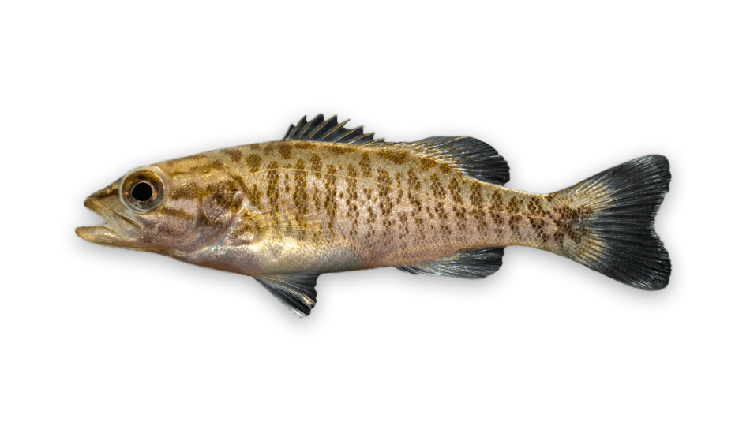
Micropterus dolomieu
Smallmouth, Bronzeback, Brown bass, Brownie, Smallie, Bronze bass, Bareback bass, Small mouth bass
Smallmouth bass have a slender but muscular fusiform body shape making them powerful swimmers. They are generally brown, appearing sometimes as black or green (seldom yellow) to dark brown dorsally which fades to a yellowish white ventrally, with red or brown eyes. They have dark brown vertical bars or blotches along the body and dark brown horizontal bars on the head. The smallmouth's colouration and hue may vary according to environmental variables such as water clarity, spawning cycle or diet. The upper jaw of a smallmouth bass extends to the middle of the eye. They have two dorsal fins which are separated by a shallow interdorsal notch.
The smallmouth bass are found in clearer water than the largemouth, especially streams, rivers, rocky areas, around stumps and also sandy bottoms of lakes and reservoirs. It can also survive in a stronger current than other black bass. The smallmouth prefers cooler water temperatures than its cousin the largemouth bass and may be found in both still and running water.
North America: St. Lawrence-Great Lakes system, Hudson Bay (Red River) and Mississippi River basins from southern Quebec in Canada to North Dakota and south to northern Alabama and eastern Oklahoma in the USA. Introduced into many countries for sport fishing. Several countries report adverse ecological impact after introduction.
Carnivorous, their diet comprises crayfish, amphibians, insects, and smaller fish, while the larvae feed on various zooplankton and insect larvae. Adults also cannibalize the young of other parents.
Smallmouth bass are good eating and very tasty. They have firm, mild-tasting meat that is easy to cook.
Can be successfully caught on a wide range of artificial lures, including crankbaits, hair jigs, plastic jerkbaits, artificial worms, spinnerbaits, and all types of soft plastic lures, including curly tail grubs or tubes with lead head jigs. They may also be caught with a fly rod using a dry or wet artificial fly, nymphs, streamers, or imitations of larger aquatic creatures, such as hellgrammites, crawfish, or leeches. Floating topwater popper fly patterns and buzz baits are also popular for smallmouth fishing. Good bait: crayfish (work best), nightcrawlers, minnows, hellgrammites, and leeches.