Common names
Bream, Brim, Sunny, Copper nose
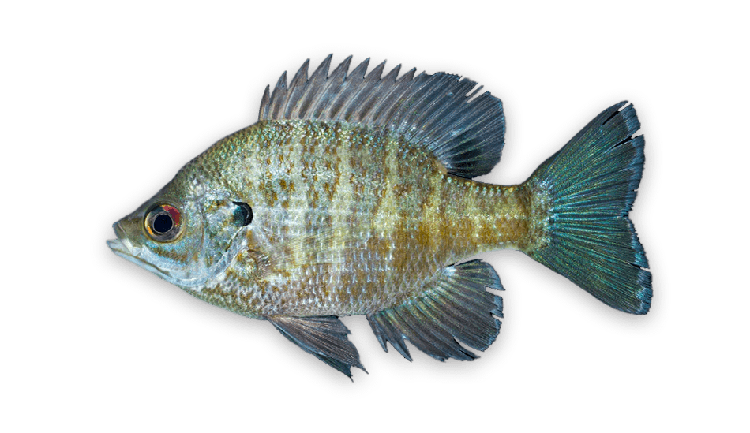
Lepomis macrochirus
Bream, Brim, Sunny, Copper nose
Bluegill have a prominent dark blue or black "ear" (blotch) on an extension of the gill cover called the opercular flap (hence the name). They are characterized by their deep, flattened bodies. They have a terminal mouth, ctenoid scales, and a lateral line that is arched upward anteriorly. The sides of its head and chin are commonly a dark shade of blue. They have typically olive-green backs, with a blue or purplish sheen along the sides and a fiery orange to yellow belly. Faint vertical bars may be present along the sides, breeding males may have more blue and orange colouration on their flanks. Bluegill's colour can vary from population to population, they typically have a very distinctive colouring.
Bluegill usually hide around and inside old tree stumps in swamps and other underwater structures (e.g. snags) and can live in either deep or very shallow water. Bluegills also like to find shelter among aquatic plants and in the shade of trees along banks, and will often move from one cover to another depending on the time of day or season.
The bluegill occurs naturally in the United States east of the Rocky Mountains from coastal Virginia to Florida, west to Texas and northern Mexico, and north to western Minnesota and western New York. Today they have been introduced to almost everywhere else in North America, and have also been introduced into Europe, South Africa, Zimbabwe, Asia, South America, and Oceania.
They are omnivorous and will consume anything they can fit in their mouth, but mostly feed on insects and their larvae. Bluegill spawn throughout summer, congregating in large "beds". Anglers may find 30-40 shallow nests scooped out in sandy areas.
Bluegills are often times referred to as panfish because they are best cooked in a frying pan over an open fire or on the stove. Bluegills can make a great campfire meal.
Either fished on the bottom or suspended below a float. Use a small hook, #6 or #8, with a split shot sinker about 6 inches up the line. Concentrate on water less than 6 feet deep. For artificial baits, a 1/8 oz. “beetle spin” with a white or chartreuse body on ultralight tackle is excellent. Good bait: live worms, nightcrawlers or crickets work best; other options are grubs, sand maggots or grass shrimp.
Redear sunfish, Orangespotted sunfish