Common names
Yellowbelly sunfish, Redbreasted bream
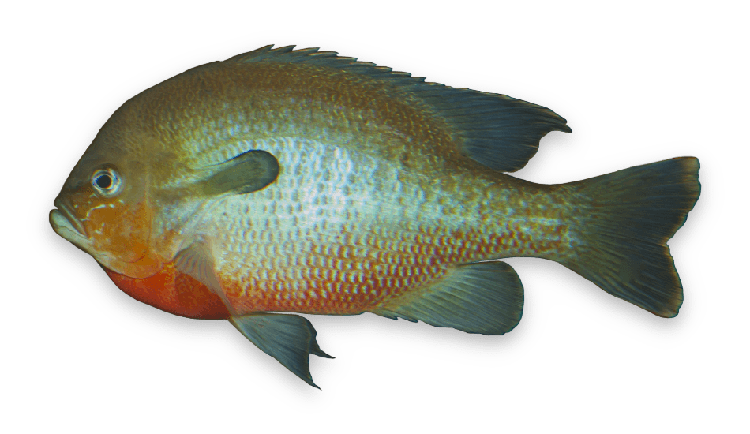
Lepomis auritus
Yellowbelly sunfish, Redbreasted bream
The redbreast sunfish is recognized by its lengthy black opercular flap, extending beyond most other sunfish in its range. The head exhibits a few blue iridescent vermiculations, and small teeth are observed, particularly on the roof of the mouth. Faint vertical bars adorn the olive-green bodies of both sexes, becoming more pronounced as the background colouration transitions to blue-green near the lateral line. Males boast darker ventral colouration, varying from orange-yellow to orange-red, while the caudal fin sports a shallow fork with possible orange to red-pigmentation. The redbreast sunfish features a yellow, orange, or red breast and belly accompanied by a bluish-green body, adorned with rusty spots. The distinctive black extension of their gill covers gives the appearance of ears. Females, less vibrant in colour than males, possess a black protective covering on their gills and short, round pectoral fins, with mouths reaching just under the front of their eyes.
The species prefers vegetated and rocky pools and lake margins for its habitat. The redbreast sunfish tends to be more of a cool-river species but also inhabits freshwater lakes and streams.
North America: Eastern Rivers of USA and Canada. At least one country reports adverse ecological impact after introduction.
The redbreast sunfish is an opportunistic feeder whose diet includes insects, snails, and other small fish & invertebrates. As is typical for the sunfishes, the female redbreast sunfish lays her eggs (about 1000) in a substrate depression built by the male. The male guards the eggs and fry. It is common within the redbreast sunfish's native and introduced range for hybridization with other sunfish species to occur.
The sweet, flaky, white flesh is excellent eating, but they don't have a lot of meat per fish.
They can also be caught using small lures or flies. Most anglers use light spinning tackle to catch redbreast sunfish. It is popular with fly anglers in the winter because it will more readily strike a moving fly than will bluegills in cooler water. Good bait: nightcrawlers, crickets, grasshoppers, waxworms, or mealworms.