Common names
Shellcraker, Georgia bream, Cherry gill, Chinquapin, Improved bream, Rouge ear sunfish, Sun perch
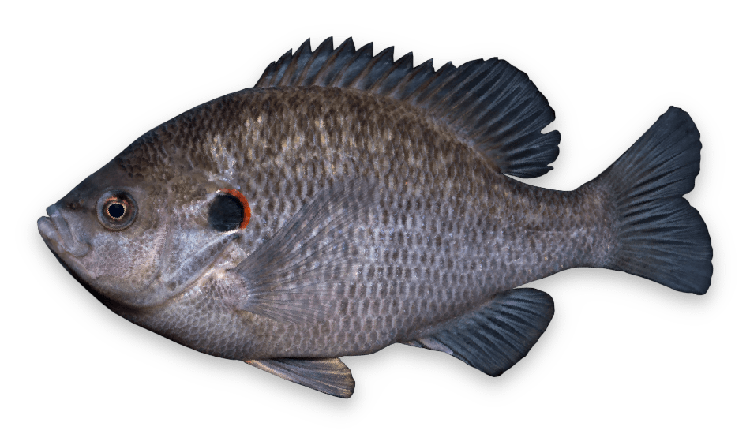
Lepomis microlophus
Shellcraker, Georgia bream, Cherry gill, Chinquapin, Improved bream, Rouge ear sunfish, Sun perch
The redear sunfish has a roundish & flattened body. Its snout is pointed, and it has a small mouth. Long, pointed pectoral fins, located behind its head, characterize its form. The coloring is dark olive green on the top of its body, fading to white on its lower sides and belly. Dorsally dark-colored and ventrally yellow-green, the male has a cherry-red edge on its operculum, while females display orange coloration in this area. Resembling the bluegill in general structure, the redear sunfish differs in coloration and somewhat larger size. It also exhibits faint vertical bars traveling downwards from its dorsal.
In the wild, the redear sunfish inhabits warm, quiet waters of lakes, ponds, streams, and reservoirs. They prefer to be near logs and vegetation, and tend to congregate in groups around these features. This sunfish is also located in many freshwater marsh wetlands.
North America: Savannah River in South Carolina to Nueces River in Texas, north in Mississippi River basin to southern Indiana and Illinois in the USA. However, this fish has also been widely introduced to other locations in the United States outside of its native range.
The favorite food of this species is snails, which it obtains by cracking their shells, hence this feisty gamefish's common name: shellcracker. They are also believed to feed on algae, aquatic worms,copepoda, midge larvae, ephemeropteran and odonata nymphs, crayfish, small fish, and fish eggs. During spawning, males congregate and create nests close together in colonies, and females visit to lay eggs. The redear sometimes hybridizes with other sunfish species
While not commonly promoted as a food source, redear sunfish are quite edible and can be transformed into a tasty camp meal.
The best time to catch them is from late spring to early summer when they are spawning. They tend to feed on the bottom, so sinkers are essential when fishing for redear sunfish. Many anglers opt to fish for them with heavy-weighted flies or sinking flies. A 20-gauge lead wire wrapped around a hook will help the bait sink. Anglers should use small hooks since they have small mouths. The best methods to use for catching redear sunfish include drift fishing and still fishing. Good bait: live bait such as insects, earthworms, and grubs.