Common names
Pond perch, Common sunfish, Punkie, Sunfish, Sunny, Kivver
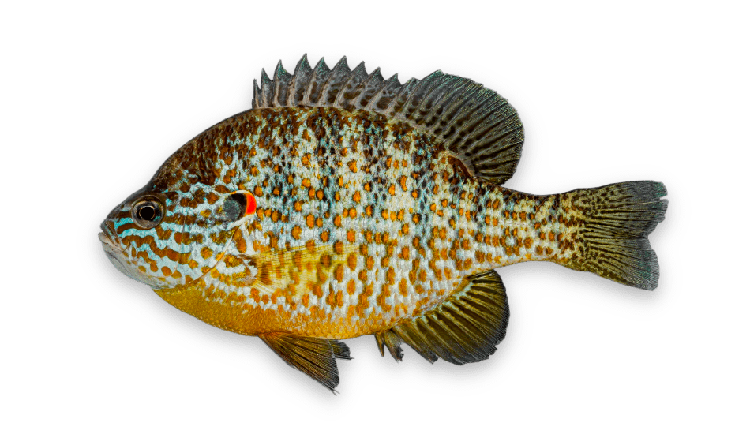
Lepomis gibbosus
Pond perch, Common sunfish, Punkie, Sunfish, Sunny, Kivver
Pumpkinseed have a small body that is shaped much like a pumpkin seed (compressed, saucer-shaped body). The pumpkinseed is easily recognized by the wavy and iridescent blue lines that radiate from the mouth along the side of its head. The sides of the body fade from olive, covered with gold and yellow flecks, to blue-green covered with orange spots, to a yellow or orange belly. The sides are covered with vertical bars that are a faint green or blue, which are typically more prevalent in female pumpkinseeds. Orange spots may cover the dorsal, anal, and caudal fins and the cheeks have blue lines across them. The pumpkinseed is noted for the orange-red spot on the margin of its black gill cover. The pectoral fins of a pumpkinseed can be amber or clear, while the dorsal spines are black. They have a small mouth with an upper jaw stopping right under the eye.
They typically live in warm, calm lakes, ponds, and pools of creeks and small rivers with plenty of vegetation. They prefer clear water where they can find shelter to hide. They tend to stay near the shore and can be found in numbers within shallow and protected areas.
Their natural range in North America is from New Brunswick down the east coast to South Carolina. It then runs inland to the middle of North America and extends through Iowa and back through Pennsylvania. Pumpkinseed sunfish have however been introduced throughout most of North America. They can now be found from Washington and Oregon on the Pacific Coast to Georgia on the Atlantic Coast. Yet they are primarily found in the northeastern United States and more rarely in the south-central or southwestern region of the continent. In Europe, pumpkinseeds are considered an invasive species.
Pumpkinseed sunfish usually travel together in schools which can also include bluegills and other sunfish. They are active during the day and rest near the bottom of the water or in protected areas in rocks or near submerged logs at night. They are carnivorous and feed on a variety of small prey both at the water surface and at the bottom. Among their favourites are insects, small molluscs and crustaceans (such as small crawfish), worms, minnow fry, small frogs or tadpoles, and even cannibalizing other smaller pumpkinseeds.
The meat is mild and flaky, and although the fillets are smaller than other panfish species, they are very good to eat.
Use ultralight tackle such as a 2-4 lb test line and a size 10 panfish hook with bait or a small 1/64th ounce jig. If the water is murky or stained, add a small bobber to your line as a bite indicator. During the early season, fly fishing with small red and white, yellow and black or black and white popping bugs, black or brown rubber spiders or small black or brown nymph flies is an excellent method to catch Pumpkinseed. Rubber spiders and nymph flies of black or brown colours usually work best. Good bait: earthworms, grubs, crickets, grasshoppers, pieces of crayfish and leeches.
Longear sunfish, Redear sunfish, Orangespotted sunfish