Common names
Squeteague, Gray trout, Seatrout
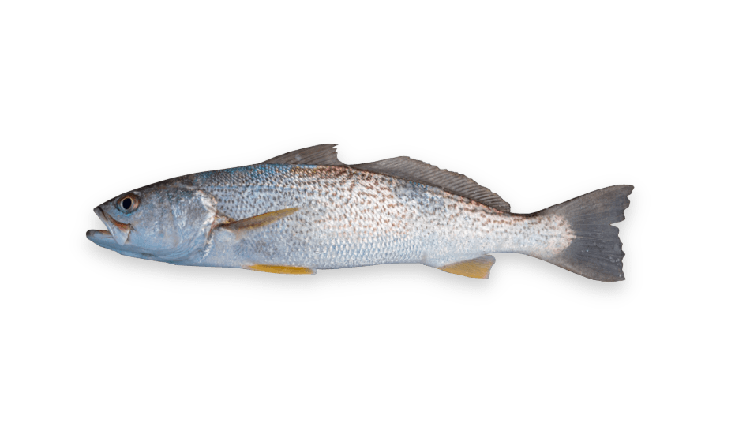
Cynoscion regalis
Squeteague, Gray trout, Seatrout
Weakfish are dark olive-green on top and silvery below, burnished on the back and sides with purple, lavender, green, blue, golden or copper. The sides are flecked with dark blotches that form wavy lines running down and forward, but not into the fins. Their fins are yellow, the dorsal fin has a deep notch, and the tail fin is squared. They have two large canine teeth in their upper jaw. The tip of their tongue is coloured black. The origin of its name is based on the weakness of the mouth muscles, which often cause a hook to tear free, allowing the fish to escape. The spot pattern distinguishes weakfish from the spotted seatrout because the spots do not appear on the tail or second dorsal fins.
Occur usually in shallow coastal waters over sand and sandy mud bottoms. Juveniles are euryhaline. During summer the fish move to their nursery and feeding grounds in river estuaries.
Western Atlantic: Nova Scotia, Canada to northern Florida, USA. Introduced in Europe.
They spawn in nearshore or estuarine areas between April and October. Considered as schooling fish which feed primarily on shrimp, crab and small fish.
Weakfish have a unique flavour, similar to their relatives in the drum family. They have a medium flavour with a nice briny tang. The meat flakes delicately, making it suitable for roasting, pan sauteing, or frying.
Drifting the back bays with a float rig loaded with bait is an effective way to catch them, but small bucktails, spoons, soft plastics, epoxy jigs, fluke-style plastics and swimbaits work regularly as well. Good bait: shedder crab and bloodworms.