Common names
Blue-fin Trevally, Blue-finned Trevally, Spotted Trevally, Bluefin Jack, Bluefin Kingfish, Bluefinned Crevalle, Blue Ulua
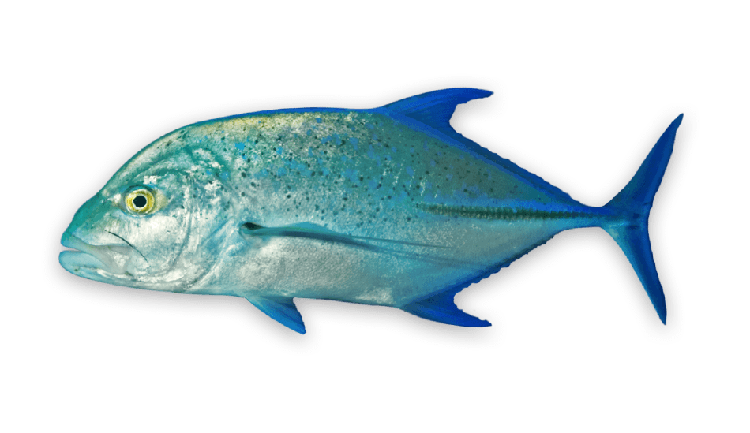
Caranx melampygus
Blue-fin Trevally, Blue-finned Trevally, Spotted Trevally, Bluefin Jack, Bluefin Kingfish, Bluefinned Crevalle, Blue Ulua
Bluefin trevally are easily recognised by their electric blue fins, tapered snout and numerous blue and black spots on their sides. The upper body of the bluefin trevally is a silver-brassy colour, fading to silvery white on the underside of the fish, often with blue hues. After they reach lengths greater than 16 cm (6.3 in), blue-black spots appear on the upper flanks of the fish, with these becoming more prolific with age. The pelvic and pectoral fins are white, with the pectoral fin having a yellow tinge. Juveniles lack these obvious colours and must be identified by more detailed anatomical features such as fin ray and scute counts. Some juvenile fish have also been recorded as having up to five dark vertical bars on their sides.
The bluefin trevally occurs in a wide range of inshore and offshore marine settings throughout its range, including estuarine waters. In the inshore environment, the species is present in almost all settings including bays, harbours, coral and rocky reefs, lagoons, sand flats and seagrass meadows.
Distributed throughout the tropical waters of the Indian and Pacific Oceans. In Australia from Western North West Cape, Rowley Shoals, Scott/Seringapatam Reefs, Ashmore and Cartier Islands, WA, and NE of Darwin, NT, to Coila Lake, NSW; also at Norfolk Island, Lord Howe Island, Christmas Island, Cocos (Keeling) Island.
The bluefin trevally is a strong predatory fish, with a diet dominated by fish and supplemented by cephalopods and crustaceans as an adult. Juveniles consume a higher amount of small crustaceans, but transfer to a more fish based diet as they grow. The species displays a wide array of hunting techniques ranging from aggressive midwater attacks, reef ambushes and foraging interactions with other larger species, snapping up any prey items missed by the larger animal.
Has firm, dense, slightly oily meat. They can be dry if overcooked, but Grilled, BBQ’d or Pan Fried lightly they are a pleasant eating fish. Skin is usually taken off to remove the dark oily bloodline.
Bluefin Trevally like to chase things and will have no interest in a slow-moving lure. For larger fish, usually found farther from shore, large poppers and jerk baits will work well. Lures with surf casters also work well, as do jigs, spoons, and feathers. Good baits: marine worms, prawns, squid, cut bait and small fish.