Common names
Lowly trevally, Barrier trevally, Giant kingfish, Ulua
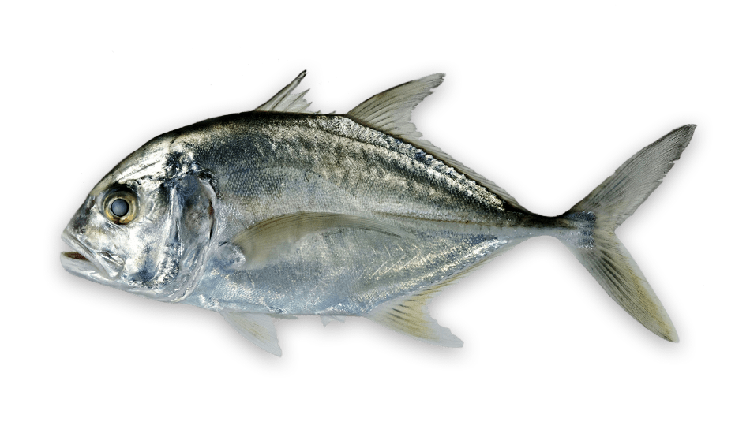
Caranx ignobilis
Lowly trevally, Barrier trevally, Giant kingfish, Ulua
Giant trevally are distinguished by their steep head profile, and strong tail scutes. They are normally a silvery colour with occasional dark spots, but males may be black once they mature while females are a much lighter-coloured, silvery-grey. All the fins are generally light grey to black, although fish taken from turbid waters often have yellowish fins, with the anal fin being the brightest. The leading edges and tips of the anal and dorsal fins are generally lighter in colour than the main part of the fins. It is the largest fish in the genus Caranx (trevallies, jacks and kingfishes). The giant trevally is similar in shape to a number of other large jacks and trevallies, having an ovate, moderately compressed body with the dorsal profile more convex than the ventral profile, particularly anteriorly. The caudal fin is strongly forked, and the pectoral fins are falcate, being longer than the length of the head. The lateral line has a pronounced and moderately long anterior arch, with the curved section intersecting the straight section below the lobe of the second dorsal fin. The chest is devoid of scales with the exception of a small patch of scales in front of the pelvic fins.
It is a semipelagic fish known to spend time throughout the water column, but is mostly demersal in nature. The species is most common in shallow coastal waters in a number of environments, including coral and rocky reefs and shorefaces, lagoons, embayments, tidal flats and channels. They commonly move between reef patches, often over large expanses of deeper sand and mud bottoms between the reefs.
The giant trevally is distributed throughout the tropical waters of the Indo-Pacific region. In Australia trevally species are commonly found along the New South Wales Coast.
The giant trevally is an apex predator in most of its habitats and is known to hunt individually and in schools. The species predominantly takes various fish as prey, although crustaceans, cephalopods and molluscs make up a considerable part of their diets in some regions. Novel hunting strategies including shadowing monk seals to pick off escaping prey, using sharks to ambush prey, and leaping to catch birds have been observed in this species. The giant trevally reproduces in the warmer months, with peaks differing by region.
Although local anglers consider trevally to be poor eating, the flesh of smaller fish up to about 6 kg is white, firm, slightly dry and actually has a pleasant flavour. The flesh of larger fish is usually very dry.
Large surface lures, especially poppers and stick baits, are considered "the best" when targeting large giant trevally. Good baits: octopus (works best), live or dead whole fish (minnows).