Common names
Golden kingfish, Banded trevally, King trevally
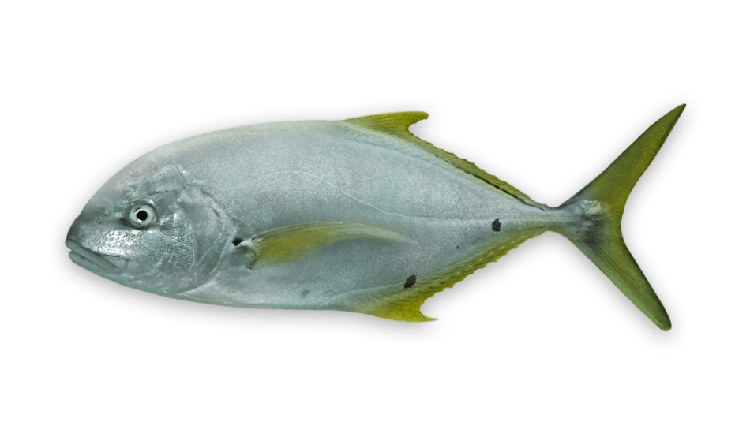
Gnathanodon speciosus
Golden kingfish, Banded trevally, King trevally
The golden trevally's colour is the species most prominent distinguishing feature, and for which it acquired its common names. Juveniles are a bright golden yellow colour over their entire body and all fins, with 7 to 11 black vertical crossbars all over their body. As the fish grows, the body becomes more silver to silvery golden and the cross bars fade or disappear, often replaced by dark blotches. Adults have golden pectoral fins and yellow breasts and bellies. These bars generally alternate between broad and narrow. The caudal fin lobes have dark tips and there is a prominent black edge to the operculum. It is similar to most other trevallies and jacks in having a compressed, oblong body, with the dorsal profile slightly more convex than the ventral profile, particularly anteriorly. The species' mouth is one of its defining features; the mouth is highly protractile and fleshy (thick-lipped).
The golden trevally predominantly occupies inshore waters of the varying substrate, although is known to occur on deeper continental shelf reefs in Australia. In coastal areas, the species inhabits rocky and coral reefs as well as open sand flats where it forages for food.
The golden trevally is widely distributed throughout the tropical and subtropical waters of the Indian and Pacific Oceans, ranging from South Africa in the west to Central America in the east, extending to Japan in the north and Australia in the south.
The golden trevally is found either as a solitary individual or in small schools as an adult. The golden trevally is a diurnal foraging carnivore which, unlike other carangids, does not normally seek out individual prey items. The highly protractile mouth possessed by the species is used to form a tube to suck prey out of both reef- and algae-dominated habitats, as well as filter organisms out of sandy substrates. The species takes a variety of prey including crustaceans such as shrimp, crabs, and amphipods, as well as molluscs and small fish.
Golden trevally are considered one of the best members of the trevally family for eating, with bleeding recommended. The fish has slightly translucent, dark-pink flesh while fresh, becoming white and juicy during cooking, although has a tendency to become dry, flaky, and fibrous.
They are usually happy to hit top-water lures such as poppers and stickbaits, while jigs and soft plastics will also work around structure. Trevally are suckers for small lures. Given their small prey preferences, it pays to keep lure size at the smaller end of the scale. Good baits: marine worms, prawns, squid and small fish strips or cubes (pilchard, skipjack, or any other baitfish).