Common names
Striped jack, Araara, Silver trevally, Skipjack trevally, Skippy
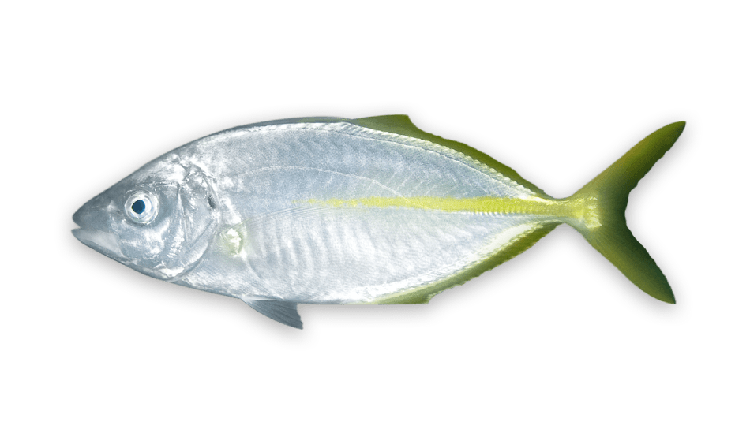
Pseudocaranx dentex
Striped jack, Araara, Silver trevally, Skipjack trevally, Skippy
White trevally are greenish-blue above, silvery below, with a rather large diffuse black spot on the upper margin of the gill cover, juveniles and subadults usually with a yellow mid-lateral stripe and a faint yellow stripe along dorsal and anal-fin bases. The posterior margin of the upper jaw is nearly vertical. Their body is deep, oval, and compressed, the tail base is very slender, and the pectoral fins are long, slender, and scythe-like, reaching almost to the straight part of the lateral line. They also have enlarged bony scales at the rear end of the lateral line. The hind margin of the upper jaw is nearly vertical and scales are absent below and before the eyes.
Adults occur in bays and coastal waters, including estuaries. Juveniles usually inhabit estuaries, bays and shallow continental shelf waters, while adults form schools near the sea bed on the continental shelf. Schools are often associated with reefs and rough bottoms.
Widespread in tropical and warm temperate areas between 40°N and 47°S, in the Atlantic, Mediterranean, Indian and Pacific Oceans.
Feed on plankton by ram-filtering and suction feeding and on bottom invertebrates. Schools of white trevally are found at the surface, in mid-water and on the bottom.
Has firm, dense, slightly oily meat. They can be dry if overcooked, but prepared correctly they are a pleasant eating fish. Skin is usually taken off to remove the dark oily bloodline.
Some effective methods to catch white trevally are bait & berley fishing, micro-jigging, soft baiting and also flyfishing. They prefer smaller prey therefore they'll readily take natural-coloured soft-baits with grub tails, micro-jigs, tiny "aji" soft-baits and krill imitations. Good baits: cut bait and shellfish baits (mussels or tuatua).