Common names
Mud pout, Horned pout, Hornpout, Mud cat
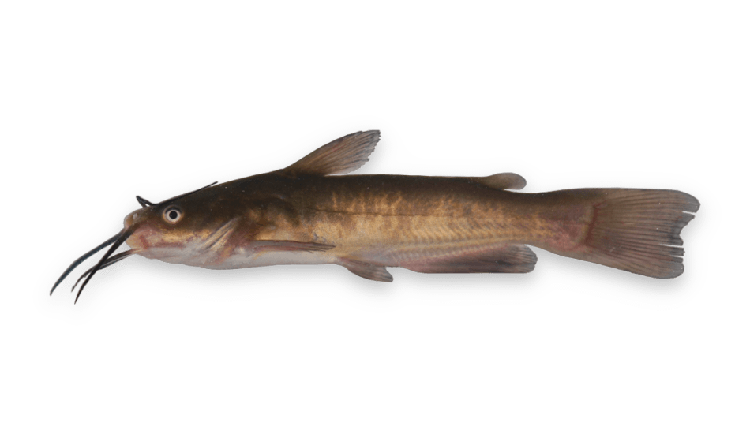
Ameiurus nebulosus
Mud pout, Horned pout, Hornpout, Mud cat
The brown bullhead features a dark brown-green colour on its back, transitioning to lighter green and yellow on the belly. Its belly is off-white or cream, and notably, it lacks scales. The entire surface of the fish is adorned with brown-black speckles. The tail is subtly notched, with dorsal and ventral lobes angling inward. The pectoral fins boast spines with 5-8 serrated teeth on their rear edge. Around its mouth, the fish has eight barbels, with the chin barbels ranging from black to yellowish brown. Juvenile brown bullheads share a similar appearance but are typically of a solid colour. To differentiate them from black and yellow bullheads, look for their distinctive yellow-black chin barbels, the absence of a hypopigmented bar at the tail's base (present in black bullheads), and the presence of 21–24 anal fin rays.
The brown bullhead thrives in a variety of habitats, including lakes, ponds, and slow-moving streams with low oxygen or muddy conditions. They can withstand a wide range of water temperatures, low oxygen levels and can survive waters with heavy pollution. Because of bullheads' tolerance of low oxygen levels, they are less threatened by winterkill and are capable of surviving in relatively extreme environments.
North America: Atlantic and Gulf Slope drainages from Nova Scotia and New Brunswick in Canada to Mobile Bay in Alabama in the USA; St. Lawrence-Great Lakes, Hudson Bay, and Mississippi River basins from Quebec west to southeastern Saskatchewan in Canada, and south to Louisiana, USA. The fish has been introduced into many European countries, such as Poland, Germany, Sweden, Norway, Finland, Romania, Estonia, Hungary, Serbia, and Croatia. Brown bullheads have also been introduced to western North America, Chile, Puerto Rico and New Zealand. Several countries report adverse ecological impact after introduction.
Brown bullhead are omnivorous benthic bottom feeders. They are scarce during the day, but come out at night to feed, searching the bottom of a lake or river for food. Their diet consists of algae, leeches, worms, molluscs, crustaceans, insects, crayfish, other smaller fish species and fish eggs. Bullheads have poor eyesight and are heavily reliant on their sensitive barbels to locate their food. These fish are omnivorous and will reportedly eat almost anything that fits in their mouth. Brown bullhead have occasionally been recorded eating their own eggs.
Like other catfish species, bullhead are some of the best-eating fish out there when they're cleaned and prepared properly. Their meat is lighter and slightly sweeter than other catfish, but are typically underutilized by anglers because of their nocturnal habits.
While the brown bullhead is available throughout the year, the optimal time to catch them is during warm nights. To maximize your chances, seek out water bodies with muddy bottoms, and swamps are often ideal. The recommended technique involves using a standard hook and worm, with the use of a slip-sinker due to the bullheads' tendency to stay near the bottom. Opt for a smaller hook for easier removal. Good bait: worms, nightcrawlers, chicken liver, small fish, bread, although they’ll eat just about anything.
Yellow bullhead