Common names
Mudcat, Polliwog, Chucklehead Cat
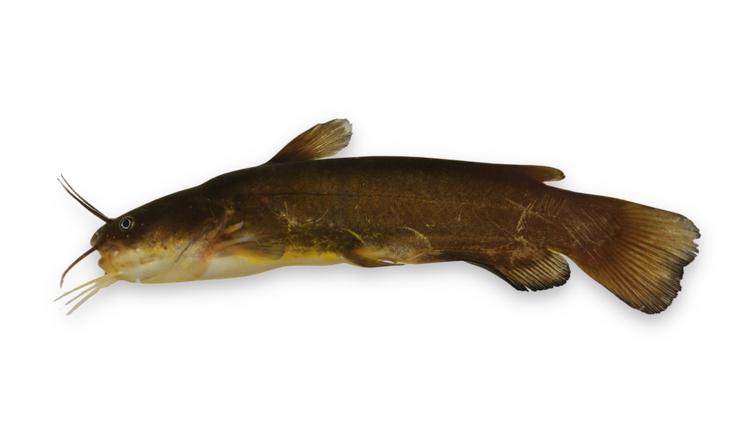
Ameiurus natalis
Mudcat, Polliwog, Chucklehead Cat
The yellow bullhead has a sturdy, compact body with coloration that ranges from yellow-olive to dark slate on the back, sometimes appearing lightly mottled depending on its surroundings. The sides are noticeably lighter, fading into a bright yellow to white belly and underside. Its tail fin is rounded, and the anal fin is relatively long, containing more rays than other bullhead species. One of its most distinctive features is the set of pale or white barbels, or “whiskers,” beneath the chin, which clearly sets it apart from black and brown bullheads. The eyes are small, and there is no dark blotch at the base of the dorsal fin. Like other bullheads, it has stiff pectoral spines with backward-facing barbs used for defense.
This species is a true bottom dweller, favoring areas with soft substrates such as mud, sand, clay, or mixed rock. Yellow bullheads are commonly found in slow-moving river pools, backwaters, creeks, ponds, and the shallow edges of lakes. They are highly adaptable and can tolerate murky, low-oxygen, and even polluted waters, as well as cleaner environments with healthy aquatic vegetation.
Yellow bullheads are widespread across central and eastern North America, ranging from the Rio Grande River north to the Great Lakes region and southeastern Canada, and east to the Atlantic coast. They have also been introduced to western parts of the United States, where they now occur as far north as Washington State. In some regions, introductions have led to ecological concerns.
The yellow bullhead has a sturdy, compact body with coloration that ranges from yellow-olive to dark slate on the back, sometimes appearing lightly mottled depending on its surroundings. The sides are noticeably lighter, fading into a bright yellow to white belly and underside. Its tail fin is rounded, and the anal fin is relatively long, containing more rays than other bullhead species. One of its most distinctive features is the set of pale or white barbels, or “whiskers,” beneath the chin, which clearly sets it apart from black and brown bullheads. The eyes are small, and there is no dark blotch at the base of the dorsal fin. Like other bullheads, it has stiff pectoral spines with backward-facing barbs used for defense.
Yellow bullhead meat is considered mild and slightly sweet, though it is generally less prized than other catfish species. The flesh can become softer during the summer months, and cleaning can be challenging due to the tough, slippery skin. Despite this, they are perfectly edible and enjoyed by many anglers who take the time to prepare them properly.
Bullheads are best caught using simple bottom-fishing setups rather than artificial lures, as they feed primarily by smell and taste. Light tackle with about a 6-pound test line and small, long-shank hooks works well, as these fish often swallow the bait. Effective baits include worms and nightcrawlers, as well as leeches, live or dead minnows, pieces of meat, and other strong-scented offerings. Bullheads are not picky and will readily take almost anything they can swallow. Good baits: worms, crickets or chicken liver fished on the bottom at night