Common names
Yellow cat, Mud cat, Johnnie cat, Goujon, Appaluchion, Opelousas, Pied cat, Mississippi cat
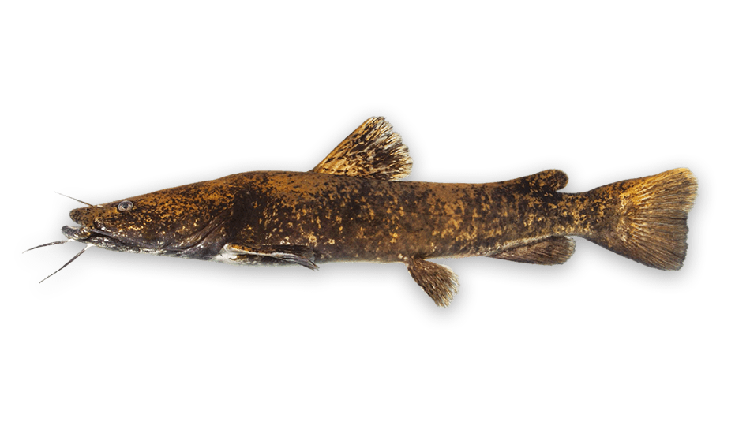
Pylodictis olivaris
Yellow cat, Mud cat, Johnnie cat, Goujon, Appaluchion, Opelousas, Pied cat, Mississippi cat
Flathead catfish have a wide flat head, as the common name suggests, but other than that, they looks like any other catfish. They have smooth, scaleless skin, whisker-like barbels around the mouth, and long spines on the dorsal (back) fin and one on each side of the pectoral (shoulder) fin. They have tiny eyes, a square-ish tail and a protruding lower jaw, these features distinguish flathead from other catfish. Flathead catfish are typically pale yellow (hence the name "yellow cat") to light brown on the back and sides, and highly mottled with black and/or brown. The belly is usually pale yellow or cream coloured. Young fish may be very dark, almost black in appearance.
Flathead catfish prefer deep pools of streams, rivers, canals, lakes and reservoirs, where the water is turbid (cloudy) and the currents are slow.
The native range of the flathead catfish includes a broad area west of the Appalachian Mountains encompassing large rivers of the Mississippi, Missouri, and Ohio basins. The range extends as far north as Canada, as far west as Texas, and south to the Gulf of Mexico including northeastern Mexico.
Spawning occurs in late spring. One or both parents excavate the nest that is usually made in a natural cavity or near a large submerged object. The nest is guarded and the eggs are agitated by the male to keep them clean and aerated. Although not exclusively nocturnal, flatheads are more active at night and may spend the day inactive in deep water or under cover. They feed on other fish smaller fish, especially catfish and sunfish.
Very good, many hardcore catfish fishermen believe a young flathead has a delightful flavour that is preferable to the other catfish species.
To catch flatheads, anglers typically fish on the bottom using heavy tackle with live (flatheads feed primarily on live baits.) or freshly cut fish. Scented lures that rattle or vibrate still work good as well, because they stimulate multiple senses, making them easier for cats to detect. Good bait: live perch, bluegill, sunfish, goldfish, or mudcats.