Common names
Grey triggerfish, Leatherjacket, Leatherneck, Taly
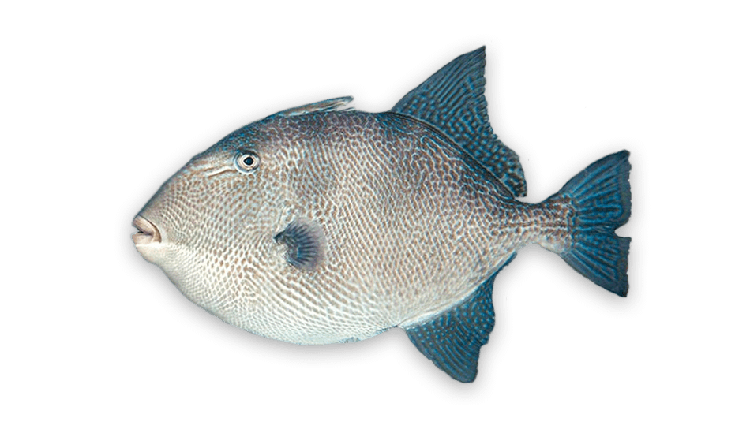
Balistes capriscus
Grey triggerfish, Leatherjacket, Leatherneck, Taly
This fish is predominantly pale grey, greenish-grey or yellowish-brown. The body has three indistinct broad dark bars and there is a pale streak on the chin. The upper part of the orbit of the eye is blue and there are some small blue spots and lines on the dorsal fins and upper parts of the body, and sometimes white dots and irregular lines on the lower parts of the body. Both the second dorsal and the anal fin present a somewhat marbled appearance. The body colour fades a little as the animal gets older: juveniles are more colourful. The small beak-like mouth at the tip of the snout has fleshy lips. The eyes are set far back near the top of the head. The body is laterally compressed and deep-bodied with tough, leathery skin. The front dorsal fin has three spines, the first being very strong and much longer than the other two. The pectoral fins are small and rounded. The outer rays of the caudal fin are elongated in larger individuals. The scales on the head and front half of the body are large while those on the hind half are smaller and smooth.
It is typically found over hard bottoms on reefs and rocky areas, in lagoons and in bays, at depths down to about 55 m (180 ft).
Grey triggerfish are found in the western Atlantic Ocean from Nova Scotia south to Argentina, including Bermuda and the Gulf of Mexico. It is also found on the other side of the Atlantic, around the British Isles, in the Mediterranean Sea and off the coast of Angola.
The grey triggerfish is a demersal species and feeds on bottom-dwelling invertebrates such as shrimps, crabs, molluscs, sea urchins, sand dollars, starfish and sea cucumbers. It has strong teeth specialised for making holes in hard-shelled prey. An interesting feeding behaviour has been observed, in which the fish positions itself vertically above a sandy seabed and puffs a stream of water out of its mouth. This disturbs the substrate and may reveal something edible. If threatened, the fish can work its way into a protective crevice and wedge itself in place by erecting its front dorsal spine. It is difficult to dislodge from this position.
Triggerfish make excellent table fare with light white sweet meat (similar to crab or grouper) that is delicious when cooked or eaten raw.
Because triggerfish have a hard, bony mouth, it is very important to use a small, very sharp hook. A typical triggerfish rig is a small weight at the end of a 15lb test line with three or more small hooks spaced out above it. Good bait: squid (works best), cut bait (cigar minnows, bonito)
Other triggerfish