Common names
Chinaman, Chinaman leatherjacket, Chinaman leather-jacket, Chinaman-leatherjacket, Chunks, Leatherjonnie, Leather-jonnie, Ocean jacket, Yellow jacket, Yellow leatherjacket, Yellow leather-jacket
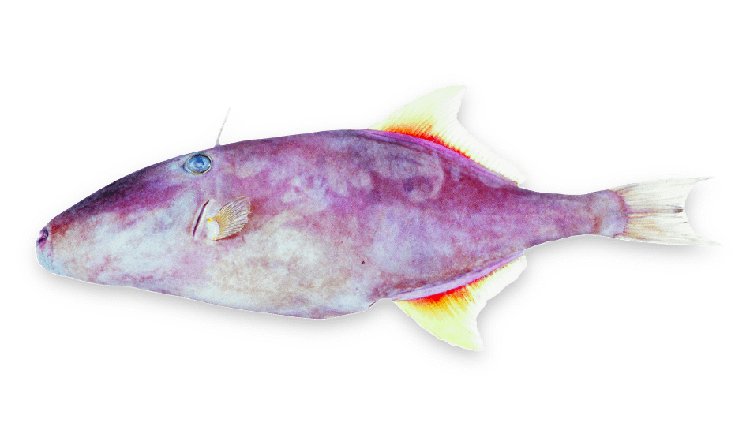
Nelusetta ayraud
Chinaman, Chinaman leatherjacket, Chinaman leather-jacket, Chinaman-leatherjacket, Chunks, Leatherjonnie, Leather-jonnie, Ocean jacket, Yellow jacket, Yellow leatherjacket, Yellow leather-jacket
Ocean jackets are characterized by their elongated snout and head, along with a distinctive sharp spine atop their heads and rudimentary pelvic fins. Female ocean jackets exhibit a bright yellowish-brown hue, featuring 3-4 narrow, indistinct stripes along their sides and vibrant yellow fins. In contrast, males have a greyish-steely blue body adorned with numerous scattered black blotches along the lower abdomen. Their dorsal and anal fins are a striking yellow, while the caudal fin showcases a bluish-grey shade. During their juvenile stage, ocean jackets display 4-5 brown stripes separated by light-yellow stripes along their sides. Like all leatherjackets, they lack scales and possess a unique skin texture resembling fine sandpaper. Notable features include a prominent, spiky first dorsal fin and very small mouths with sharp teeth, distinguishing them within their aquatic habitat.
Adults are found on the continental shelf and slope, while juveniles school seasonally in inshore waters. Juvenile ocean jackets have been caught in seagrass, over bare sand and on rocky reefs, however, adults tend to be absent from seagrass areas, appearing only offshore.
Endemic to the southern half of Australia from about Moreton Bay, Queensland, to the Murion Islands, Western Australia, and around Tasmania. The species also occurs in northern New Zealand.
They are carnivorous, feeding mainly on salps. Other food items in the diet include gastropod molluscs, crustaceans and fish. Ocean Leatherjackets are aggressive predators and often form small feeding schools. They are notorious for attacking larger fishes hooked on offshore reefs and have even been known to attack divers.
They have a mild flavour, low oiliness and are moderately moist, with firm flesh. Fillets are usually boneless, trunks usually have the backbone left in and can be cooked this way or cut into cutlets.
They have small mouths so if targeting them you need to use very small baits or soft plastics. Leatherjackets have very sharp teeth, so handle them with care. At times they will bite through your leader occasionally. Good bait: small pieces of prawn, pilchard, mullet, silver whiting, mussel, octopus, worms & squid.
Rough leatherjacket, Lowe's leatherjacket, Brownstriped leatherjacket, Rhinoceros leatherjacket, Stars-and-stripes leatherjacket, Other leatherjacket species