Common names
Freycinet's leatherjacket, Grey leatherjacket, Orange-spotted leatherjacket, Reef leatherjacket, Six-spine leatherjacket, Six-spined leatherjacket, Skottowe's leatherjacket, Variable leatherjacket
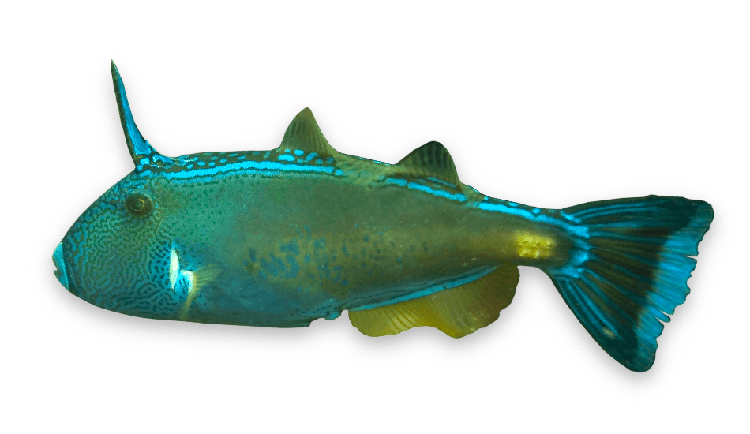
Meuschenia freycineti
Freycinet's leatherjacket, Grey leatherjacket, Orange-spotted leatherjacket, Reef leatherjacket, Six-spine leatherjacket, Six-spined leatherjacket, Skottowe's leatherjacket, Variable leatherjacket
These fish have a lengthy, moderately deep, and compressed body, featuring a tail base adorned with two to four pairs of curved spines on each side. In males, these spines are notably larger than in females. Two distinct dorsal fins are present: the first, is a prominent spine with serrations along the rear edges, followed by a tiny second spine. Adults, especially males, exhibit two to four pairs of curved spines on each side of the tail base. Both males and females possess a noticeable dark crescent-shaped band near the hind margin of the tail. Males are characterized by a bluish hue with fine blue lines and spots on the head, along with blue lines along the bases of the dorsal and anal fins. They often display a large yellow-to-orange patch or indistinct yellow blotches on the sides. In contrast, females and juveniles showcase a palette of pale greenish, yellow, or brown shades. They bear blue lines and spots on the head, accompanied by several broad dark stripes along the sides. These distinct markings set them apart within their aquatic environment.
Found on shallow to deep reefs in bays, harbours and along the coast in depths, juveniles are common in sheltered areas, especially seagrass beds.
Endemic to temperate waters of southern Australia, from south of Coffs Harbour, New South Wales, to Jurien Bay, Western Australia, and around Tasmania; also recorded from Lord Howe Island in the Tasman Sea.
They feed on benthic invertebrates, including hydroids, molluscs, crustaceans and polychaetes, as well as consuming some epiphytic algae.
Leatherjackets have white, sweet, firm and slightly moist flesh and make very good to excellent food fish.
They have small mouths so if targeting them you need to use very small baits or soft plastics. Leatherjackets have very sharp teeth, so handle them with care. At times they will bite through your leader occasionally. Good bait: small pieces of prawn, pilchard, mullet, silver whiting, mussel, octopus, worms & squid.
Yellowfin leatherjacket, Toothbrush leatherjacket, Largescale leatherjacket, Horseshoe leatherjacket, Rough leatherjacket, Bridled leatherjacket, Other leatherjacket species