Common names
Kingfish, Cavalla, Sierra
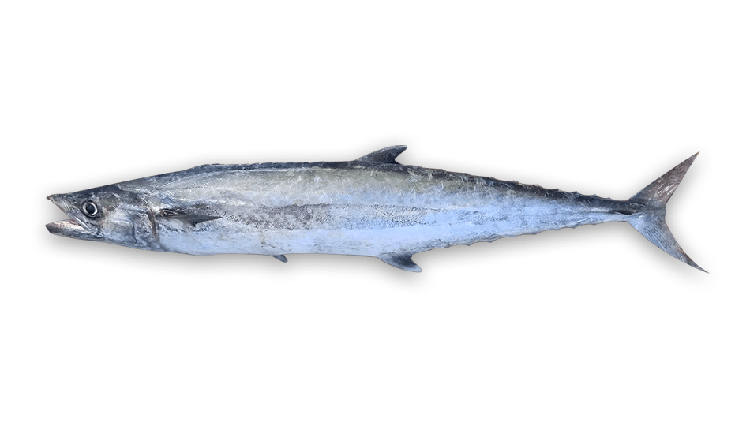
Scomberomorus cavalla
Kingfish, Cavalla, Sierra
King mackerel is a medium-sized fish, their entire body is covered with very small, hardly visible, loosely attached scales. The first (spiny) dorsal fin is entirely colourless and is normally folded back into a body groove, as are the pelvic fins. The front of the first dorsal fin lacks a dark blotch. The lateral line starts high on the shoulder, dips abruptly at mid-body and then continues as a wavy horizontal line to the tail. The colouration is bluish-olive on the back, fading to silver with a rosy iridescence on the sides, fading to white on the belly. Juveniles may have yellowish spots, similar to Spanish mackerel. Its cutting-edged teeth are large, uniform, closely spaced and flattened from side to side.
Coastal to offshore waters, often occur inshore, in the mouths of inlets, piers and harbours. They may occasionally be found in deep water.
Common in the coastal zone from North Carolina to Brazil, it occurs as far south as Rio de Janeiro, and occasionally as far north as the Gulf of Maine.
King mackerel are carnivores, feeding on fish, squid, and shrimp. They’re voracious feeders and have been observed leaping out of the water in pursuit of prey. Large schools have been found to migrate over considerable distances along the Atlantic US coast, water temperature permitting. They spawn offshore in mid-summer.
Kingfish have a sweet, tender, and amazingly flaky texture, which does not taste too fishy. May contain elevated mercury levels, and potentially ciguatoxic in certain areas.
Kings feed on small fish and squid and take both natural and artificial bait. Lures should be flashy sub-surface lures or large fish-like plugs. Use a 20-pound line and tackle, or heavier for larger kings, with a wire or mono leader. Good bait: live bait such as pogies, herring, Spanish sardine, ballyhoo, and mullet.
Cero, S. regalis, Spanish mackerel, S. maculatus (both have gently sloping lateral lines and a dark blotch on front of first dorsal fin)