Common names
Mackerel, Spotted cybium, Bay mackerel, Spotted mackerel
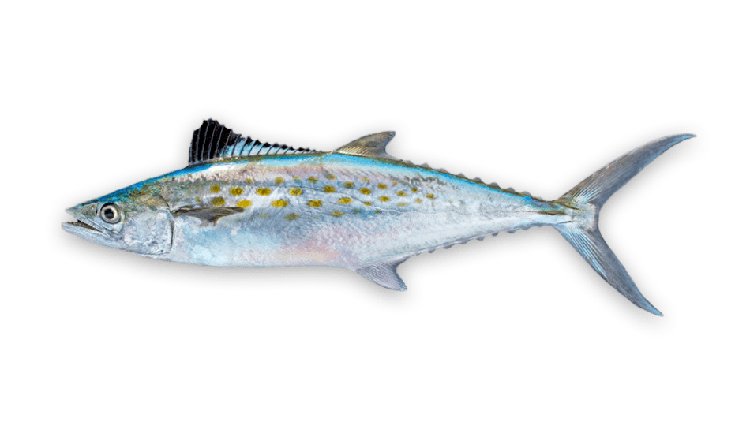
Scomberomorus maculatus
Mackerel, Spotted cybium, Bay mackerel, Spotted mackerel
Spanish mackerel have a bluish-green back, fading to silvery sides and belly. The silvery-marked sides have about three rows of round irregular golden-yellow spots. The first (spiny) dorsal fin has a blueish-black blotch at the front. Posterior membranes are white with a black edge. Their lateral line is gradually curving down from the upper end of the gill cover toward the caudal peduncle. Its single row of cutting-edged teeth in each jaw (around sixty-four teeth in all) are large, uniform, closely spaced and flattened from side to side. They are covered with very tiny scales. Spanish mackerel can be distinguished from king mackerel by their smaller size and the absence of the lateral line that drops abruptly below the second dorsal fin.
They are a shallow water species, preferring sand bottom and are frequently found over grass beds and reefs.
Western Atlantic: Canada to Cape Cod to Miami (USA) and Gulf of Mexico coasts from Florida, USA to Yucatan, Mexico. Absent in the Bahamas.
Schooling fish that migrate northward in spring, returning to southerly waters when the water temperature drops. Spawn offshore from spring through summer. They are speedy carnivores and usually prey on prey mainly on herring, menhaden, sardines, mullet, needlefish, anchovy and, sometimes, even shrimp, crabs, and squid.
Very good, an especially good-eating finfish, produces an attractive plate-size cutlet or an essentially boneless fillet. May contain elevated mercury levels.
Angling techniques include trolling or casting with small shiny spoons, dusters or jigs. Also, respond well to cast and trolled minnow and skirted lures. Sharp teeth require the use of wire leaders. Good baits: slimy mackerel, yellowtail and tuna, pilchards and other oily fish.
Cero, S. regalis (has yellowish stripe on sides), King mackerel, S. cavalla (lateral line drops sharply below second dorsal fin)