Common names
Kinkfish, Peto, Guarapucu, Ono, Thazard batard
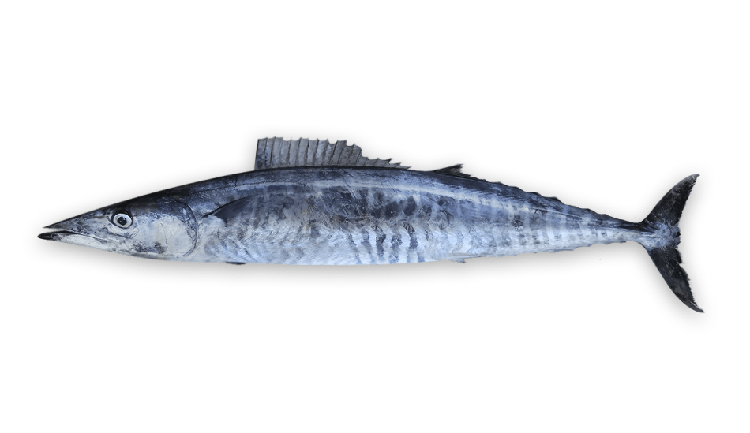
Acanthocybium solandri
Kinkfish, Peto, Guarapucu, Ono, Thazard batard
Wahoo's body is elongated somewhat compressed, torpedo-shaped and covered with tiny scales. Their back is an iridescent blue, while the sides are silvery with a pattern of 24 to 30 wavy irregular vertical blue bars and the belly is whitish. These colours fade rapidly at death. The mouth is large, and the teeth are small but strong, triangular, compressed, and finely serrated. Both the upper and lower jaws have a somewhat sharper appearance than those of king or Spanish mackerel. They have a pointed head and a long beaky snout. The tail is somewhat half-moon-shaped, and the stem of the tail is lined with small, attractive finlets. The first dorsal fin is low and long.
Offshore waters.
Wahoo are found in tropical and subtropical waters around the world in the Atlantic, Pacific and Indian ocean. They are found in tropical waters year-round but are also found in higher latitudes during the summer.
Known for their tremendous runs and shifts of direction, they are among the fastest fish in the sea. They mainly feed on squid and fish, including frigate mackerel, butterfish, porcupine fish, round herring and squid. Wahoo tend to be solitary or occur in loose-knit groups of two or three fish. Where conditions are suitable, they can be found in schools around 100 or more.
Excellent, wahoo are mild-tasting, with a firm, lean texture and large, circular flake. May contain high mercury levels.
Wahoo are caught by trolling bait and artificial lures (minnow lures, high speed lures, bibless minnows, etc.) on flatlines. Wahoo also respond aggressively towards skirted or diving lures. Good baits: slimy mackerel, blue runner, pogies, croakers, mullet, pinfish and small tuna.
Cero mackerel