Common names
Narrow-bar, Narrow-barred mackerel, Snook, Spaniard, Spanish mackerel
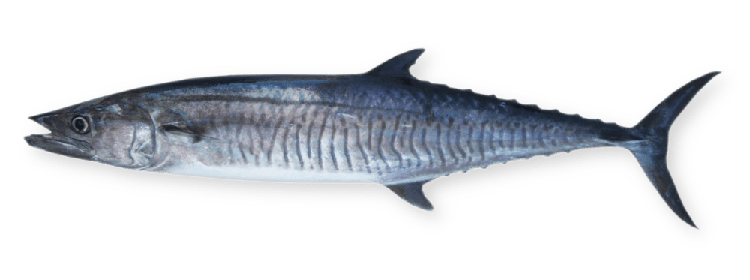
Scomberomorus commerson
Narrow-bar, Narrow-barred mackerel, Snook, Spaniard, Spanish mackerel
Narrow-barred Spanish mackerel are vivid blue to dark grey in colour along their backs and flanks and fade to a silvery blue-grey/whitish on the belly. On the sides they have 40-50 dark grey vertical bars extending below the lateral line, bars occasionally breaking up into spots ventrally. Juveniles have large black oval spots on the body and fewer than 20 bars. The first dorsal fin is black except formiddle third of the fin. Their body is elongated and strongly compressed. They have got jaws with a single series of 5-38 sharp triangular teeth. Their body is covered in small scales, with no anterior corselet present. The single lateral line is abruptly bent ventrally below the rear of the second dorsal fin. Caudal peduncle with a well-developed keel, flanked on each side by a smaller keel. Dorsal fins are separated by a narrow space.
A pelagic fish, inhabiting near the edge of the continental shelf to shallow coastal waters, often of low salinity and high turbidity, also found in drop-offs, and shallow or gently sloping reef and lagoon waters.
Found in a wide area centering in Southeast Asia, but as far west as the east coast of Africa and from the Persian Gulf and along the northern coastal areas of the Indian Ocean, and as far east as Fiji in the South West Pacific ocean. They are common down both sides of Australia as far south as Perth on the west coast and Sydney on the east coast. They are also found as far north as China and even Japan.
Feed primarily on small fishes like anchovies, clupeids, carangids, also squids and penaeid shrimps. Usually hunts solitary and often swim in shallow water along coastal slopes. Eggs and larvae are pelagic. Known to undertake lengthy long-shore migrations, permanent resident populations also seem to exist.
They are a highly sought-after table fish. Have a strong, distinctly ‘fishy’ flavour, medium to very high oiliness and medium-dry, firm flesh. The thin skin can be eaten, but it’s usually sold skinned and has few bones, which are easily removed.
Respond well to aerodynamic and shiny casting spoons, small diamond jigs, cast and trolled minnow and skirted lures. Sharp teeth require the use of wire leaders. Good baits: slimy mackerel, yellowtail and tuna, pilchards and other oily fish.