Common names
Southern kingcroaker, King whiting, Carolina whiting, Sea mullet, Roundhead, Whiting, Ground mullet, Whitefish
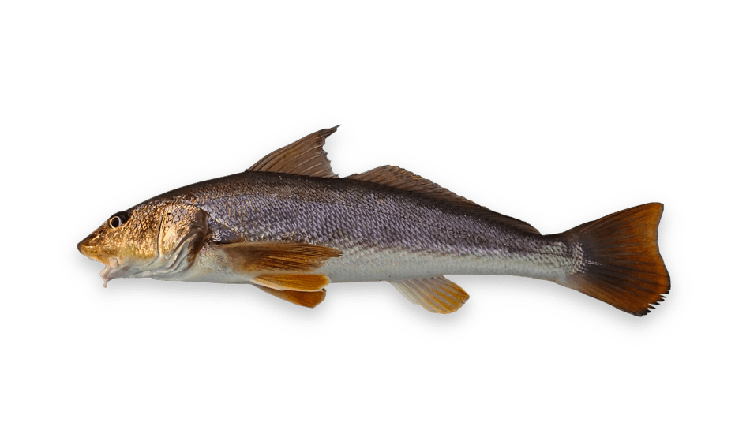
Menticirrhus americanus
Southern kingcroaker, King whiting, Carolina whiting, Sea mullet, Roundhead, Whiting, Ground mullet, Whitefish
Southern kingfish are slender fish, their upper jaw projects further than the lower and the snout overhangs the mouth. There is a single small rigid barbel ("whisker") on the fleshy lower lip. The dorsal fin is divided into two parts. The tail fin has a characteristic slightly concave upper lobe and a rounded lower lobe. The colour of the fish is silvery grey, sometimes with a coppery sheen, and paler grey below. There are sometimes 7 to 8 several diagonal broad slanting bands or blotches of darker colour on the back and the sides of the fish. This makes them harder to see in the sandy surf areas where they live. The bands or blotches never form a V-shape. The margins of their fins are often dark. The pelvic, anal and caudal fins are often yellowish in colour.
It is found in places where the seabed is sand or mud, often on sandy beaches. The juveniles can tolerate low salinity levels and are often found in estuaries.
Western Atlantic: Cape Cod in Massachusetts, USA to northern Argentina.
Prefer high wave action areas such as sand bars where the crashing waves dislodge and suspend small crabs and other small crustaceans. Their diet consists mainly of small crustaceans such as shrimps and crabs but amphipods, polychaete worms, molluscs and small fish are also eaten and it also scavenges for detritus and carrion
Known for their firm and mild-flavoured white flesh. They have a rich, slightly oily flavour, similar to seatrout.
Southern Kingfish do not take to artificial lures well. An efficient fishing technique is bait used with small hooks on bottom rigs, fished just past the breaking waves on the beach. Good bait: pieces of squid, shrimp, clams, or bloodworms.