Common names
Silver bass, Black-back
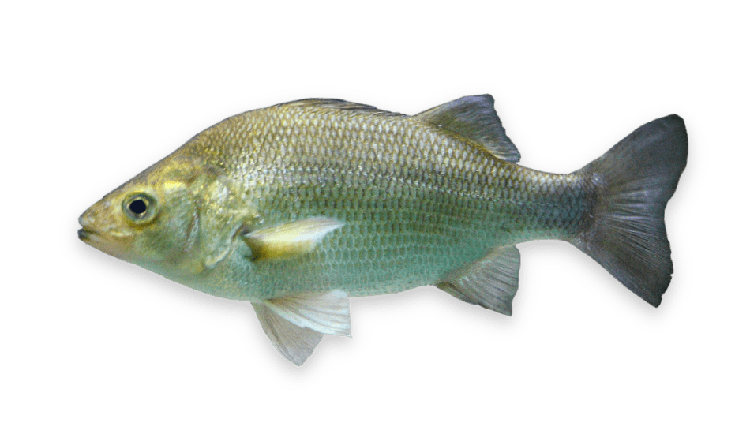
Morone americana
Silver bass, Black-back
White perch are not true perch but rather fish in the temperate bass family. They have a silvery, greenish-grey body with faint lines on the sides, a whitish belly, and a highly domed, grey or blackish-black. Their lower jaw is slightly projecting. They have a mildly forked tail, three spines on their anal fin (the second and third spine are the same length), and a deep notch in their dorsal fin. The first part of the dorsal fin also has several spines. The body is deep and laterally compressed, being deepest just ahead of the dorsal fin. The two dorsal fins are slightly joined by a membrane at the base. They generally do not have stripes.
Occur in fresh, brackish and coastal waters. Inhabit pools and other quiet-water areas of medium to large rivers, usually over mud.
North America: Atlantic Slope drainages from St. Lawrence drainage in Quebec, Canada south to Savannah River in Georgia, USA. Transplanted to Great Lakes (except Superior) and Ohio-Missouri-Mississippi river systems of mid-western USA; elsewhere as far west as Colorado, USA.
White perch move to brackish water and submerge themselves in deep pools to over-winter. As temperatures rise in spring they move toward their spawning grounds, which are usually upstream in shallower freshwaters. After spawning they move back into deeper water for the summer months. White perch are known to eat the eggs of many native species. At times, fish eggs are 100% of their diet. They prefer to eat small minnows like mud minnows and fathead minnows.
The raw meat is of a somewhat pinkish hue, but when cooked, it is white and flaky, with a mild flavour. At times, a parasite known as Lironeca ovalis is located in the gills.
Small stickbaits are the perfect size for white perch. They'll also take hair jigs or soft plastics and inline spinners. Good bait: worms, minnows and shrimp.