Common names
Sand bass, Silver bass
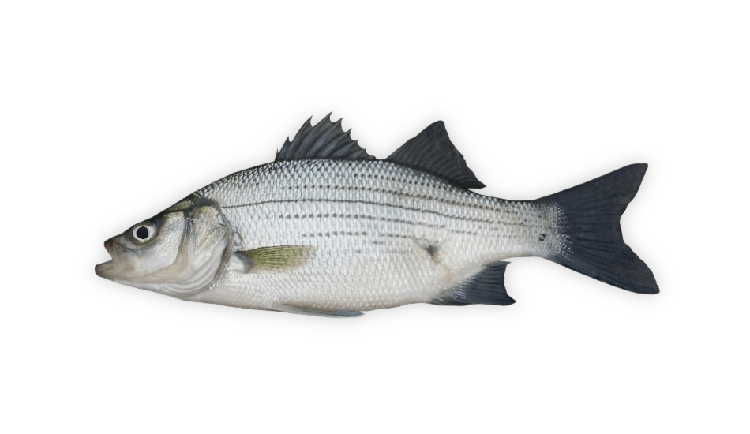
Morone chrysops
Sand bass, Silver bass
White bass' main colour is silver-white to pale green. Their back is dark, with white sides and belly, and with several incomplete lines or stripes running horizontally on each side of the body. The stripes below the lateral line are broken, and the first stripe below the lateral line is not complete to the tail. They have large, rough scales and two dorsal fins. The anterior dorsal fin is much harder and appears to have spines on them. Although these are not true spines, this type of fin is called a spinous ray. The posterior of the two dorsal fins is much softer and is thus called a soft ray. The body is deep and compressed laterally with a distinctively arched back. Adults resemble young striped bass, and the two are often confused.
Open water of moderate to large rivers and reservoirs with large connecting rivers.
North America: St. Lawrence-Great Lakes, Hudson Bay (Red River) and Mississippi River basins from Quebec in Canada and South Dakota and south to Louisiana in USA; and Mississippi River in Louisiana to Rio Grande in Texas and New Mexico, USA.
White bass are found in high densities in the upstream segment of rivers. Male white bass move upstream in big schools to a dam or other barrier in early spring, females follow, and spawning occurs in moving water over shoals or hard bottoms. Females lay adhesive eggs that stick to rocks and gravel. White bass eat minnows and open-water baitfish like gizzard or threadfin shad.
White bass meat is a healthy addition to the dinner table, as it is rich in proteins and omega-3 fatty acids. However, white bass often is accompanied by a strong, fishy taste that many find unappealing.
Two popular lures are - the "slab" type lure, which can be jigged or cast and retrieved, and the plastic grub on a jig head. Plastic tails or minnows, small silver-coloured spinners, spoons, and crankbaits will also work well. Good bait: live minnows and worms. (white bass are not particularly choosy)