Common names
Bass, Rockfish, Striper, Linesider, Vonget, Rock, Sunshine bass, Palmetto
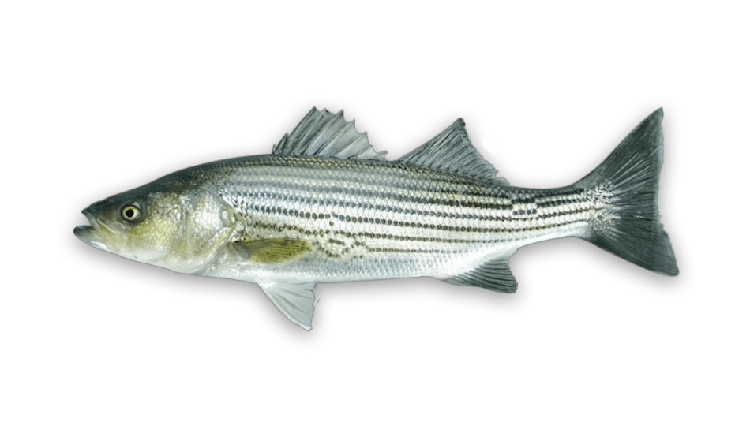
Morone saxatilis
Bass, Rockfish, Striper, Linesider, Vonget, Rock, Sunshine bass, Palmetto
Striped bass are silvery, shading to olive-green on the back and white on the belly, with seven or eight uninterrupted black horizontal stripes on each side of the body (from the gills to their tail). Stripes are absent on young fish, which may resemble white bass. The dorsal fin is clearly separated into spiny and soft-rayed portions. They have stout streamlined slender bodies. Striped bass have two distinct tooth patches on the back of the tongue, whereas white bass have one tooth patch. Striped bass have two sharp points on each gill cover, and white bass have one. Additionally, the second spine on the anal fin is about half the length of the third spine in striped bass, and about two-thirds the length of the third spine in white bass.
The striped bass is anadromous, and native to a variety of habitats including shores, bays, estuaries, offshore, lakes, reservoirs, and rivers. They prefer cooler waters.
Striped bass are native to the Atlantic coastline of North America from the St. Lawrence River into the Gulf of Mexico to Louisiana. Striped bass have been introduced to the Pacific Coast of North America and into many of the large reservoir impoundments across the United States by state game and fish commissions for the purposes of recreational fishing and as a predator to control populations of gizzard shad. They have also been introduced into waters in Ecuador, Iran, Latvia, Mexico, Russia, South Africa, and Turkey, primarily for sport fishing and aquaculture.
During hot summers, striped bass become less active and must find cool water to survive. They are anadromous fish that migrate between fresh and saltwater. In coastal populations, individuals may ascend streams and travel as much as 100 miles inland to spawn. There are also land-locked populations that complete their entire life cycle in freshwater. Spawning takes place in freshwater. Striped bass are opportunistic feeders and primarily piscivorous, feeding predominantly on members of the herring family such as gizzard shad and threadfin shad.
Very good, striped bass have white extremely versatile meat with a mild flavour and a medium texture.
Use heavy tackle with 3- to 4-oz. weights in high-flow areas. Baitfish-like lures, such as heavy jigs, sinking or floating lures in white, chrome or chartreuse are very effective. Good bait: live shad, herring, menhaden, mackerel, eels, squid, clams, anchovies, bloodworms, shad, nightcrawlers and sandworms.